
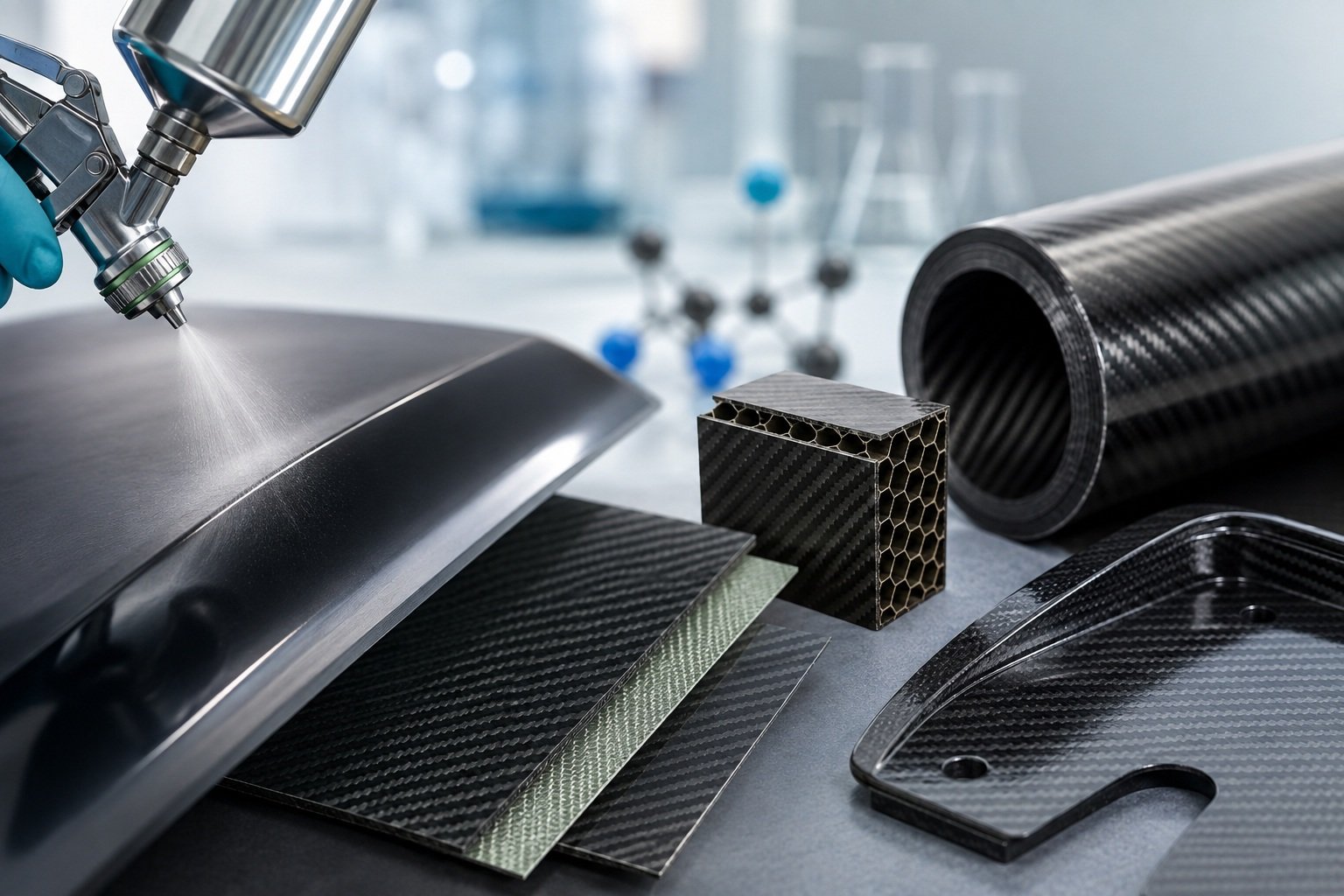
Manufacturers working with advanced material systems know that coatings for advanced composites determine whether a finished product survives real world stress or fails prematurely under load. Innokan Technochem develops high performance coating systems that enhance durability, sealability, and surface functionality for composite and specialty material applications across multiple industries.
Composite materials often carry high expectations around strength to weight ratio, but the surface layer protecting that composite structure matters just as much as the core material itself. This blog explains why coating selection is critical for advanced composites and how Innokan approaches formulation for these specialized applications.
Understanding the Role of Coatings for Advanced Composites
Advanced composites combine multiple material layers to achieve strength, flexibility, or weight advantages over traditional materials. However, these composite structures often remain vulnerable at their surface, where moisture, UV exposure, and mechanical abrasion can degrade performance over time if left unprotected.
A well engineered coating acts as the first line of defense against these environmental stresses. It prevents moisture ingress that could weaken internal bonding layers, blocks UV degradation that causes surface embrittlement, and adds abrasion resistance that extends the service life of the finished component.
Without proper coating protection, even a structurally sound composite can fail prematurely due to surface level damage that gradually compromises the material underneath.
Innokan’s Coating Technologies for Advanced Materials
Innokan’s coatings portfolio spans release coatings, heat seal coatings, and UV curable systems, each engineered for specific functional requirements across packaging and advanced material applications. Release coatings built on PMMA polymers offer controlled release properties along with optical clarity, useful for protective film applications on composite surfaces.
UV curable coatings harden instantly under UV light exposure, forming a durable, high gloss or matte finish that protects underlying material while improving visual appeal. This rapid curing process also supports faster production cycles compared to traditional thermal curing systems, an advantage for manufacturers running high volume production lines.
These coating systems draw on the same research foundation that supports Innokan’s packaging and industrial coating lines, allowing formulation knowledge to transfer efficiently across different application categories.
Barrier Protection and Environmental Resistance
Advanced composite applications fre
Barrier Protection
quently operate in demanding environments, whether that means outdoor exposure, chemical contact, or repeated mechanical stress. Barrier coatings protect against moisture, oxygen, and contaminant ingress that could otherwise compromise the composite structure from the surface inward.
Innokan’s high barrier coating technology, originally developed for packaging applications requiring moisture and oxygen resistance, extends naturally into advanced composite protection where similar barrier principles apply. This cross application benefit means formulation expertise gained in one sector often translates into effective solutions for another.
Chemical resistance also matters significantly for composites used in industrial or automotive settings, where contact with fuels, cleaning agents, or process chemicals is common during the product’s service life.
Surface Functionality Beyond Basic Protection
Modern coatings do more than simply protect a surface. They can improve adhesion for subsequent bonding steps, provide controlled release properties for manufacturing processes, or enhance the visual finish of a finished composite component.
For manufacturers producing composite panels or components with visible surfaces, coating clarity and gloss level become important specification criteria alongside protective performance. Innokan’s UV coating systems address this dual requirement, delivering both durability and aesthetic finish quality in a single formulation.
This paragraph stays brief intentionally, keeping the reading rhythm varied across the section.
Customization for Specific Composite Applications
Advanced composites vary widely in their base materials, intended applications, and performance requirements, which means coating formulations need customization rather than one size fits all solutions. Innokan works directly with clients to understand substrate composition, environmental exposure conditions, and mechanical stress requirements before recommending a coating system.
This customization process often includes activation temperature adjustments, resistance property tuning, and clarity or finish modifications based on the specific composite application. Manufacturers producing components for construction, automotive, or industrial equipment sectors typically require different coating profiles even when starting from a similar base polymer chemistry.
Clients can also explore related adhesives solutions when composite manufacturing requires both coating and bonding chemistry within the same production process, simplifying vendor coordination for complex material assemblies.
Sustainability in Advanced Composite Coatings
Environmental considerations increasingly influence coating formulation decisions across advanced material industries. UV curable systems offer inherent sustainability advantages since they typically contain minimal solvent content and cure without generating significant VOC emissions compared to traditional thermal curing coatings.
Innokan’s commitment to green chemistry principles, detailed further on its research and development page, extends into its advanced composite coating development. This ensures manufacturers can meet performance requirements while also satisfying increasingly common environmental compliance expectations from clients and regulatory bodies.
Manufacturers evaluating coating suppliers should request environmental data alongside standard performance specifications, particularly when supplying industries with strict sustainability reporting requirements.
Testing Coating Performance Before Full Scale Production
Composite manufacturers should always test coating performance on representative samples before committing to full production runs, since coating behavior can vary based on substrate surface energy, curing equipment, and application method. Innokan supports this validation process by providing sample batches for client side testing under actual production conditions.
This testing phase should evaluate adhesion strength, curing time, barrier performance, and finish quality under conditions that closely mirror the manufacturer’s actual production environment rather than idealized laboratory settings alone. Batch to batch consistency also deserves attention, particularly for manufacturers running continuous production lines where formulation variation could create visible defects across a product run.
Readers interested in comparing coating categories in more depth may find this guide on specialty coatings for packaging useful for understanding how heat seal, release, and UV systems differ across application types.
Choosing a Coating Partner for Advanced Material Manufacturing
Selecting the right coating supplier for advanced composite applications requires evaluating technical depth alongside product availability. A supplier capable of adjusting formulations for specific substrate chemistry and environmental exposure conditions offers far more value than one selling only standardized products.
Innokan’s technical team works alongside manufacturers throughout formulation development, sample testing, and production scaling to ensure coating performance matches real application demands. This collaborative approach reduces the risk of costly coating failures after a composite product reaches the field.
If your advanced material application needs a coating partner with genuine formulation expertise, contact Innokan Technochem today to discuss your project requirements and request samples for testing.
Frequently Asked Questions
What makes a coating suitable for advanced composite materials?
Suitable coatings need to bond well with the composite surface while providing protection against moisture, UV exposure, and mechanical abrasion relevant to the intended application. Compatibility between the coating chemistry and the composite’s surface energy also plays a major role in achieving strong, lasting adhesion. Manufacturers should test coating performance on their specific substrate before scaling to full production to confirm compatibility.
Do UV curable coatings work well for advanced composite applications?
UV curable coatings work effectively for many composite applications, offering fast curing times, low VOC content, and durable finish quality. They perform particularly well where production speed and environmental compliance both matter. However, substrate compatibility and curing equipment availability should be confirmed before selecting UV curable systems for a specific composite manufacturing process.
How do barrier coatings protect composite materials from environmental damage?
Barrier coatings create a protective layer that blocks moisture, oxygen, and contaminants from reaching the composite structure underneath. This prevents degradation of internal bonding layers and reduces the risk of premature material failure caused by environmental exposure over the product’s service life, particularly in outdoor or industrial settings.
Can coating formulations be customized for specific composite manufacturing needs?
Yes, coating formulations can be adjusted based on substrate composition, environmental exposure, and mechanical performance requirements specific to a manufacturer’s application. This customization process typically involves sample testing and iterative formulation adjustments before finalizing a coating for full scale production use.
What information should manufacturers provide when requesting a composite coating sample?
Manufacturers should share details on the composite substrate material, intended application environment, required finish appearance, and any mechanical or chemical resistance targets. Providing sample material for direct coating trials also helps the supplier confirm performance before committing to larger production volumes.