
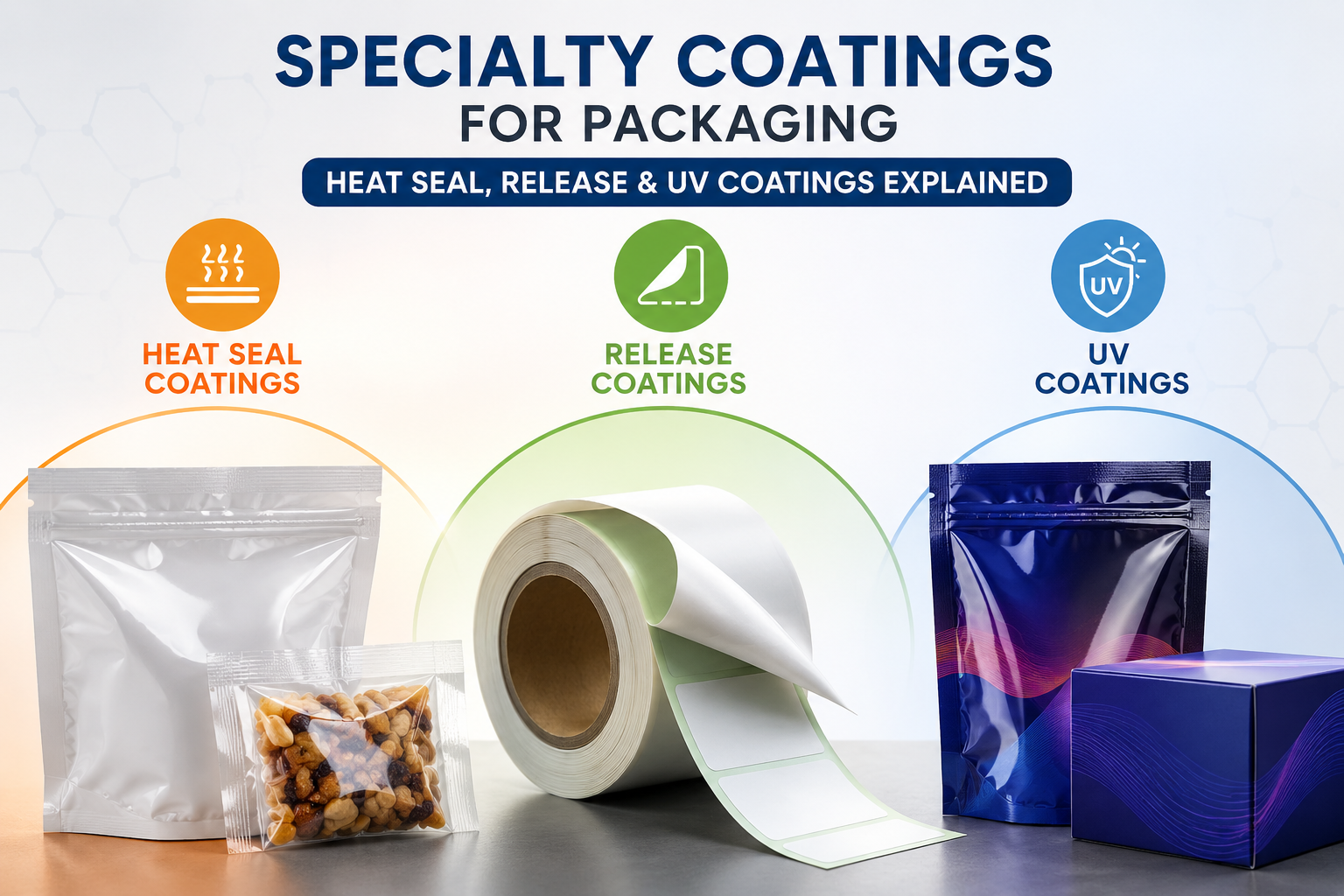
Packaging performance often comes down to the coating applied to a substrate, not just the base material itself. Specialty coatings determine whether a package seals properly, releases cleanly from liners, or resists scratches and UV exposure during shipping and shelf life. This guide explains the three most common specialty coatings used in packaging today: heat seal coatings, release coatings, and UV coatings.
Innokan Technochem manufactures all three specialty coating types at its Haryana facility, working directly with packaging converters to solve specific sealing, release, and protection challenges. The breakdown below draws on that applied manufacturing experience.
What Heat Seal Coatings Do and Why Packaging Relies on Them
Heat seal coatings allow two packaging surfaces to bond together when exposed to heat and pressure, without requiring additional adhesive layers.
Manufacturers apply heat seal coatings to films, papers, or laminates, then activate the bond during the packaging process using heated sealing bars.
This sealing mechanism makes heat seal coatings essential for flexible packaging, blister packs, and pouch sealing across food, pharmaceutical, and consumer goods industries. A well-formulated heat seal coating creates a strong, tamper-evident seal while still allowing the package to open cleanly when the end user needs access, balancing security with convenience.
Heat seal coatings also need to perform consistently across a range of sealing temperatures and dwell times, since packaging lines vary widely in speed and equipment setup. A coating that seals reliably across this range reduces production rejects and protects product integrity during transit.
What Release Coatings Do and Where They Apply
Release coatings create a low-adhesion surface that allows materials to separate cleanly without damage or residue. Manufacturers apply release coatings to liners, backing papers, and films used in label production, tape manufacturing, and other applications requiring controlled separation.
Why Release Force Matters
The release force a coating provides matters significantly in real-world use. Too little release force makes liners difficult to remove, frustrating end users and slowing down label application lines. Too much release force risks premature separation during storage or transport, which can ruin an entire production run. Precision-formulated release coatings strike the right balance for each specific application and line speed.
Release coatings also need to maintain consistent performance across temperature and humidity fluctuations, since packaging materials often travel through varied storage and shipping conditions before reaching the end user.
What UV Coatings Do and Why They Enhance Packaging
UV coatings cure almost instantly when exposed to ultraviolet light, forming a hard, glossy, or matte protective layer over printed packaging surfaces. This near-instant curing process allows UV coatings to support high-speed production lines without the long drying tunnels that solvent-based coatings require.
Benefits of UV Coatings for Packaging
Beyond speed, UV coatings significantly improve a package’s resistance to scratches, moisture, and UV light degradation, extending shelf appeal and protecting printed graphics during handling and shipping. Premium packaging for cosmetics, consumer electronics, and retail products frequently uses UV coatings specifically to maintain a glossy, scratch-resistant finish that holds up through the supply chain.
UV coatings also produce minimal VOC emissions during curing, since the process relies on photoinitiator activation rather than solvent evaporation, supporting both production efficiency and environmental compliance simultaneously.
Comparing Heat Seal, Release, and UV Coatings by Function
Heat seal coatings solve a bonding problem, allowing packaging surfaces to join securely without separate adhesive application. Release coatings solve a separation problem, ensuring liners and backing materials detach cleanly when needed. UV coatings solve a protection and appearance problem, shielding printed surfaces from damage while enhancing visual appeal.
Many packaging applications use more than one specialty coating across different components of the same product. A flexible pouch, for example, might use a heat seal coating on the sealing surface, a release coating on a peelable liner, and a UV coating on the outer printed surface for shelf protection and shine.
How to Choose the Right Specialty Coating for Your Application
Identifying the right specialty coating starts with defining the functional problem you need to solve: bonding, separation, or surface protection. From there, consider your production line speed, since UV coatings and heat seal coatings both support faster throughput than coatings requiring extended drying time.
Key Factors to Consider
Substrate compatibility matters equally. Coatings must adhere properly to the base film, paper, or laminate while maintaining consistent performance across the temperature and humidity conditions your packaging will encounter from production through end use. Testing a coating under your actual production and storage conditions, rather than relying solely on supplier data sheets, helps avoid costly surprises after a full production run.
Work With a Specialty Coatings Manufacturer That Understands Packaging
Selecting between heat seal, release, and UV coatings requires technical expertise matched to your specific packaging application. Innokan Technochem formulates all three specialty coating types with rigorous quality control, helping packaging converters achieve reliable sealing, clean release, and lasting visual protection. Contact Innokan’s team today to discuss a specialty coating solution tailored to your production line and product requirements.
Frequently Asked Questions
What is the main difference between heat seal coatings and adhesives?
Heat seal coatings activate through heat and pressure during the packaging process, creating a bond without a separate adhesive application step.
Traditional adhesives, by contrast, often require separate application and curing before sealing occurs.
Why do release coatings sometimes fail to release liners cleanly?
Release failures typically happen when the coating’s release force doesn’t match the application’s requirements, often due to incorrect formulation, inconsistent coating weight, or exposure to temperature and humidity conditions outside the coating’s tested range.
Do UV coatings work on all types of packaging substrates?
UV coatings perform best on substrates that allow proper UV light penetration and adhesion, including most films, papers, and laminates used in printed packaging. Highly textured or certain dark substrates may require formulation adjustments to cure properly.
How do heat seal coatings affect packaging shelf life?
Heat seal coatings create a secure barrier seal that protects packaged products from contamination and moisture ingress, directly supporting shelf life. A properly formulated heat seal coating maintains seal integrity throughout the product’s expected shelf life and shipping conditions.
Can one package use multiple specialty coatings at once?
Yes, many packaging products combine heat seal coatings for sealing surfaces, release coatings for peelable liners, and UV coatings for printed exterior protection, since each coating solves a distinct functional requirement within the same package.
How does Innokan support packaging converters with specialty coating selection?
Innokan’s technical team evaluates the specific bonding, release, or protection challenge a converter faces, then formulates or recommends a specialty coating matched to the substrate, line speed, and end-use conditions, reducing the risk of production issues after scale-up.