
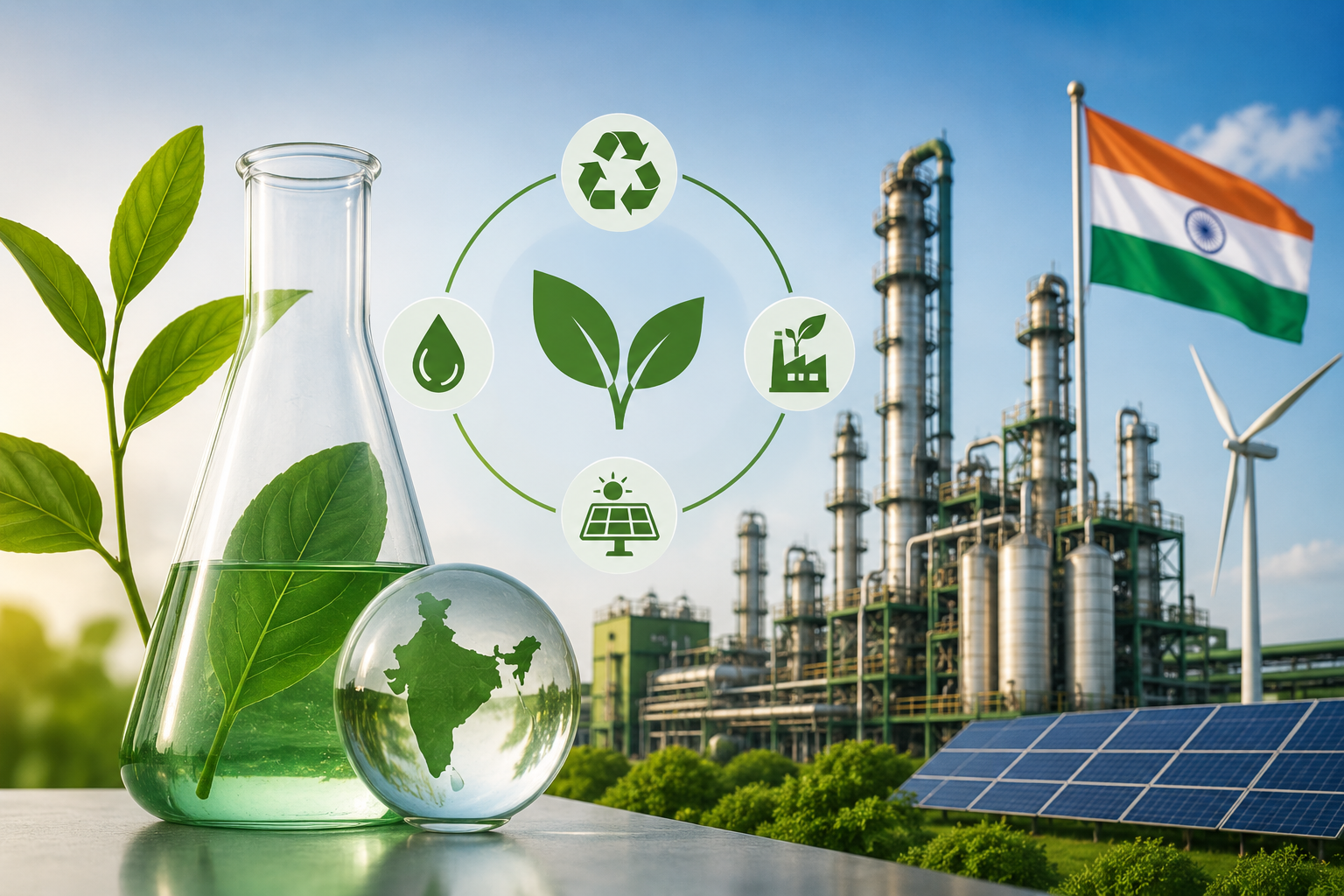
Indian manufacturers face growing pressure to reduce environmental impact without sacrificing product performance. Sustainable chemical manufacturing has shifted from a marketing buzzword to a business necessity, driven by tightening regulations, global supply chain requirements, and customer demand for greener materials. This guide explains what sustainable chemical manufacturing actually means in India today and how businesses can identify a genuinely sustainable chemical partner.
Innokan Technochem operates a state-of-the-art manufacturing facility in Kundli, Sonipat, Haryana, where green chemistry principles guide adhesive, ink, and coating production. The insights below draw directly from that operational experience.
What Defines Sustainable Chemical Manufacturing?
Sustainable chemical manufacturing integrates environmental responsibility into every stage of production, from raw material sourcing to final product formulation. This includes reducing volatile organic compound (VOC) emissions, minimizing hazardous waste, conserving water and energy, and selecting raw materials from responsible suppliers.
A genuinely sustainable chemical manufacturer doesn’t treat sustainability as an afterthought bolted onto existing processes. Instead, the company designs formulations and production workflows around cleaner technologies from the start, ensuring environmental performance and product quality improve together rather than competing against each other.
Why Indian Industries Are Prioritizing Green Chemistry
India’s regulatory landscape has tightened considerably around industrial emissions, hazardous chemical handling, and waste disposal. Packaging, printing, construction, and consumer goods companies now face stricter compliance requirements that directly affect which chemical suppliers they can use.
Beyond regulation, export-oriented Indian manufacturers must meet international sustainability standards to remain competitive in global markets. Buyers in Europe and North America increasingly require documented proof of low-VOC formulations and responsible sourcing before signing supply agreements, making sustainable chemical manufacturing a competitive advantage rather than just a compliance checkbox.
Core Technologies Behind Sustainable Chemical Production
Cleaner production technologies form the backbone of sustainable chemical manufacturing. Water-based formulations replace solvent-heavy alternatives wherever performance allows, cutting VOC emissions dramatically across adhesives, inks, and coatings. UV-curable technologies eliminate solvent evaporation entirely by curing instantly under ultraviolet light, reducing both emissions and energy consumption.
Responsible sourcing also plays a central role. Sustainable manufacturers vet raw material suppliers for environmental practices and trace inputs back through the supply chain, ensuring the final product’s sustainability claims hold up under scrutiny. Rigorous quality control systems then verify that every batch meets both performance specifications and environmental targets before it reaches a customer’s production line.
How Sustainable Manufacturing Improves Product Performance
A common misconception assumes sustainable products sacrifice performance for environmental benefit. In practice, well-engineered green chemistry often delivers equal or superior performance compared to conventional alternatives. Water-based adhesives, for example, now match the bond strength of many solvent-based formulations for porous substrates, while emitting far fewer VOCs.
UV-curable inks and coatings cure faster than solvent-based equivalents, increasing production throughput while simultaneously reducing environmental impact. This pairing of efficiency and sustainability demonstrates why green chemistry innovation has become a genuine performance driver rather than a constraint that manufacturers must work around.
Evaluating a Chemical Manufacturer’s Sustainability Credentials
Businesses should look beyond marketing language when evaluating a potential chemical supplier’s sustainability claims. Ask whether the manufacturer maintains an active research and development program focused on green chemistry, since ongoing innovation signals genuine commitment rather than a one-time certification.
Request documentation on VOC emission levels, waste management practices, and raw material sourcing policies. A transparent manufacturer provides this information readily and can explain how specific formulations reduce environmental impact compared to industry-standard alternatives. Site visits or facility audits also reveal whether sustainable practices extend across actual production operations, not just public-facing statements.
Industries Benefiting Most from Sustainable Chemical Solutions
Packaging industries gain immediate value from sustainable adhesives and coatings, since reduced VOC emissions improve worker safety and simplify regulatory compliance on high-volume production lines. Printing industries benefit from water-based and UV-curable inks that cut emissions while maintaining vibrant print quality and strong substrate adhesion.
Construction and advanced materials industries increasingly specify sustainable resins and binders to meet green building certifications and project sustainability requirements. Across every sector, sustainable chemical solutions help businesses meet both internal environmental goals and external customer or regulatory expectations simultaneously.
Building a Long-Term Sustainable Supply Partnership
Sustainable chemical manufacturing works best as a long-term partnership rather than a transactional purchase. Manufacturers who understand your specific production environment can continuously refine formulations to improve both sustainability metrics and operational performance over time.
Innokan Technochem combines green chemistry research with practical manufacturing experience to deliver adhesives, inks, and coatings that meet rigorous sustainability standards without compromising performance. Reach out to Innokan’s team to discuss how a sustainable chemical partnership can strengthen your environmental credentials and your bottom line.
Frequently Asked Questions
What makes a chemical manufacturer genuinely sustainable rather than just eco-labeled?
Genuine sustainability shows up in measurable practices: documented VOC reduction, responsible raw material sourcing, water and energy conservation, and active R&D investment in green chemistry. Manufacturers who provide transparent data and welcome facility audits typically back their sustainability claims with real operational practices.
Do sustainable chemical products cost more than conventional alternatives?
Pricing varies by formulation, but many sustainable products now match conventional pricing due to improved manufacturing efficiency and economies of scale. Long-term costs often decrease further since sustainable products reduce compliance overhead and ventilation infrastructure requirements.
How does sustainable chemical manufacturing affect product performance?
Modern green chemistry formulations frequently match or exceed conventional product performance. Water-based and UV-curable technologies, for instance, often improve production speed while simultaneously cutting emissions, proving that sustainability and performance can advance together.
Which industries in India benefit most from sustainable chemical solutions?
Packaging, printing, construction, and advanced materials industries see the strongest benefits, since these sectors face the heaviest regulatory scrutiny around emissions and waste while also serving export markets that demand documented sustainability credentials.
What questions should businesses ask before choosing a sustainable chemical supplier?
Ask about VOC emission levels, raw material sourcing transparency, ongoing R&D investment, and willingness to provide facility audits or documentation. Suppliers who answer these questions readily demonstrate genuine sustainability commitment.
How does Innokan support businesses pursuing sustainability goals?
Innokan integrates green chemistry into every stage of adhesive, ink, and coating production at its Kundli, Sonipat facility, combining cleaner technologies with rigorous quality control. The company’s R&D team works directly with clients to formulate solutions that meet specific sustainability and performance targets.