
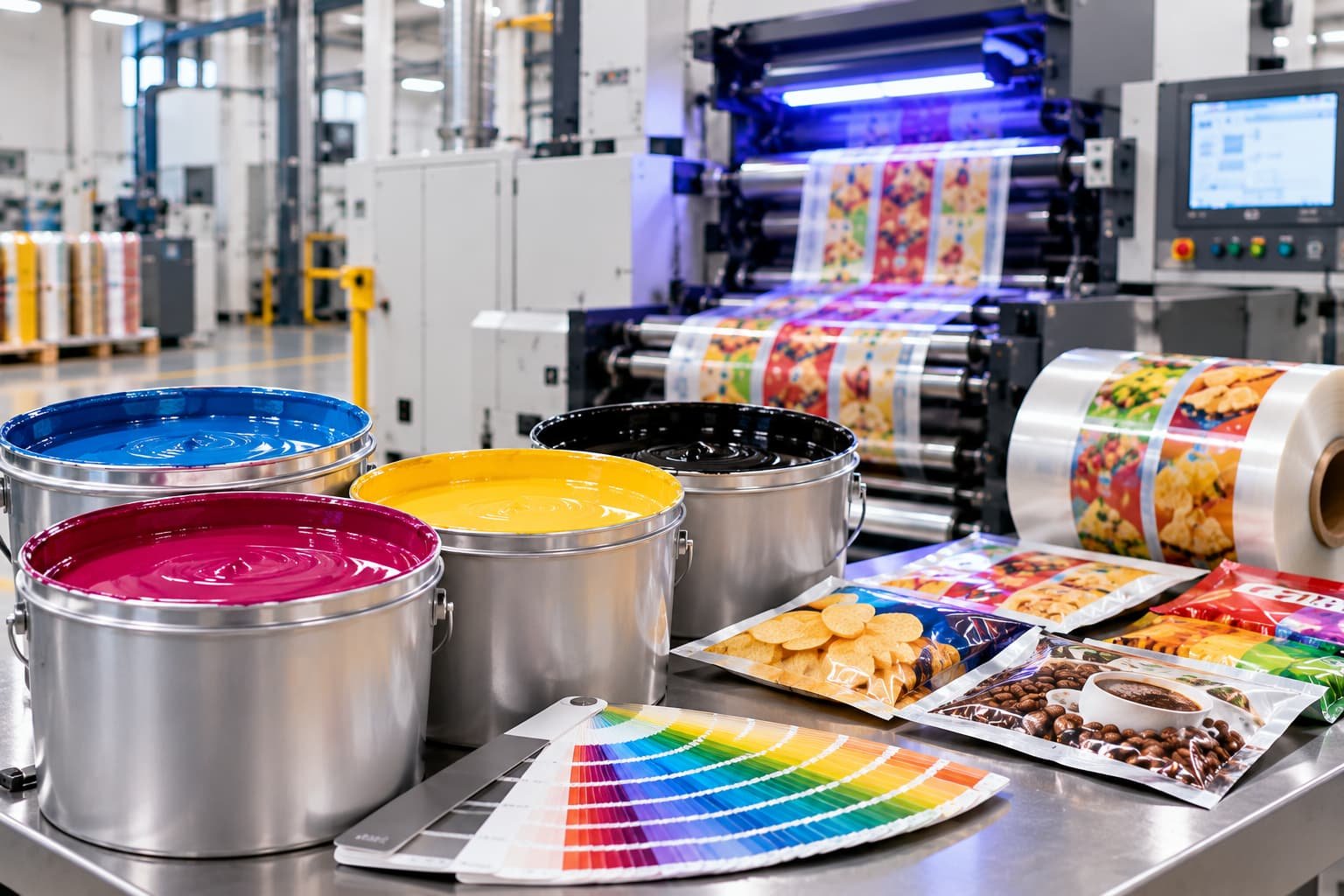
The best UV curable ink suppliers India has to offer are the ones whose inks pass trials on your substrate, your press and your curing lamps, and who deliver the same result from batch to batch. Price and brochure claims matter less than tested adhesion, stable colour, clear documentation and technical help when something goes wrong.
This guide is for printers, label converters and packaging buyers who need a repeatable selection method. It explains how UV curing works, how UV inks compare with other systems, what to test, which documents to request and which mistakes to avoid. It also shows where Innokan Technochem’s ink range fits.
What UV-Curable Inks Are and How UV Curing Works
UV-curable inks contain monomers, oligomers, pigments and photoinitiators. They do not dry by evaporation. When UV light reaches the printed film, the photoinitiators absorb it and start a chemical reaction that links the monomers and oligomers into a solid layer. Curing takes a fraction of a second under the right lamp.
That reaction needs three things to line up: an ink designed for it, a lamp that emits the right wavelengths and enough energy to reach the whole ink film. If one of those is wrong, the ink may look dry but stay under-cured. That is why supplier choice and equipment choice cannot be separated.
UV-Curable, Water-Based and Solvent-Based Inks Compared
Each ink family suits a different job.
UV-curable inks cure on the surface by light, so they can print on non-porous materials such as films, plastics, glass and metal. Innokan lists them for labels, shrink sleeves, cosmetic packaging and glass or metal printing.
Water-based inks dry as water leaves the film, so they work best on porous substrates like paper and cardboard. Innokan positions them for cartons, labels and corrugated packaging.
Solvent-based inks dry by solvent evaporation and adhere well to many non-porous materials, but they contain VOCs. Innokan’s inks page lists plastic, metal and glass uses and notes the VOC content.
Pick the family that matches your substrate and process first. Then compare suppliers within that family.
Printing Applications and Where UV Inks Fit
Innokan’s verified application list gives a useful picture. Beverage, cosmetic and health product labels benefit from scratch and chemical resistance. Shrink sleeves need inks that stay flexible enough to follow the film. Cosmetic tubes, containers and cartons often call for a high-gloss finish, and specialty or promotional packaging may use metallic, textured or spot effects.
Each application sets different demands. A sleeve ink must cure without distorting a heat-sensitive film. A glass or metal print must survive handling and filling. Tell the supplier the end use, the filling and distribution conditions and the finish you want, so the trial matches the job.
Match the Ink to Substrate, Press and Lamp
Innokan’s UV-curable ink page lists compatibility with flexographic, screen and digital printing systems. Your press type changes the ink’s required viscosity, speed and film weight, so give the supplier exact details.
Lamp type deserves special attention. Mercury arc lamps emit across a broad range of wavelengths, while UV LED lamps emit in a narrow band, typically around 365, 385, 395 or 405 nm. Industry technical papers from lamp and ink makers explain that the photoinitiator must absorb the wavelength the lamp emits. An ink designed for broad-spectrum mercury lamps may not cure fully under LED, whereas LED-formulated inks often cure under mercury lamps as well, though you should confirm this with the supplier.
Substrate matters just as much. Treated films, coated papers, glass and metal each behave differently. Dark and heavily pigmented colours absorb more UV energy, so they can need more energy or different photoinitiators than light colours. No UV ink works on every substrate, press or lamp.
Performance Tests That Reveal Real Quality
Judge UV inks on measurable results from your own line. Useful checks include:
- Use a tape test or cross-hatch test on each substrate.
- Cure level. Run a rub test or solvent rub to confirm the film is fully cured at your line speed.
- Measure colour against an approved standard, and repeat across batches.
- Print quality. Check dot gain, gloss and edge definition at production speed.
- Test scratch, rub and chemical resistance in line with the end use.
Record results for every trial. Those records become your approval baseline.
Sample Testing and Batch Consistency
Sound UV ink supplier evaluation starts with trials on real materials. Print the actual job on the actual press, then cure with your lamps at working speed. Test across a full shift if you can, because lamp output changes with age and temperature.
Consistency across batches is what separates a dependable supplier from a lucky one. Ask how the manufacturer controls raw materials and checks each batch. Request a certificate of analysis with each lot and keep retained samples. Test a second and third batch before you commit to a volume contract. Also confirm shelf life and storage rules, since UV inks are sensitive to light.
A simple scorecard keeps the comparison fair. List your must-have criteria, such as adhesion on your film, colour tolerance, lead time and support, then score each supplier’s trial results against them. Weight the criteria by their cost if they fail. Adhesion failure on a filled product usually costs far more than a slightly higher ink price.
Documents and Technical Support to Expect
A credible supplier provides a technical data sheet and a safety data sheet for each grade. The technical sheet should state suitable substrates, press types, recommended lamp type and curing guidance. Ask for written notice of any change in formulation or raw material.
After-sales support matters when production stops. Ask about response time, troubleshooting help, lead times, stock levels and who handles technical visits. India’s size makes logistics a real factor, so check delivery times to your plant.
Safety, Handling and Environmental Considerations
UV inks are low in volatile solvents compared with solvent-based inks, which helps air quality. Even so, handling needs care. Uncured inks contain reactive monomers, and many acrylate materials can irritate or sensitise skin, so the safety data sheet will specify gloves, eye protection and cleaning rules. Operators also need protection from stray UV light. Mercury lamps contain mercury and need proper disposal.
Food packaging adds a further question. Unreacted photoinitiators or ink components can migrate from printed packaging, and industry bodies such as EuPIA publish guidance on low-migration formulation and testing. Do not assume any UV ink suits food packaging. Ask for migration test data for the exact ink, substrate and use.
Common Supplier Selection Mistakes
Buyers often make the same errors:
- Comparing suppliers on price per kilogram instead of cost per good print.
- Skipping trials on the real press and lamps.
- Ignoring the match between photoinitiator and lamp wavelength.
- Approving one batch and assuming all will match.
- Overlooking safety and migration documents.
- Choosing a supplier with no local technical support.
How Innokan Technochem Supports Printing and Packaging Buyers
Innokan Technochem manufactures inks at its facility in Kundli, Sonipat, Haryana. Its UV-curable inks page describes systems built from monomers, oligomers and photoinitiators for labels, shrink sleeves, cosmetic packaging and glass or metal printing, with glossy, matte, textured and specialty finish options. The page states compatibility with flexographic, screen and digital printing and offers guidance on curing equipment and ink-film compatibility.
Innokan’s research and development page describes work on UV-curable inks that use less energy and dry faster, supported by testing and batch quality control. Innokan’s own UV-curable versus water-based ink comparison can help if you are still choosing between systems. Share your substrate, press and lamp details so the team can discuss suitability.
Choosing UV Curable Ink Suppliers India Printers Can Rely On
Reliable UV curable ink suppliers in India prove their inks on your equipment, hold colour and cure steady across batches, and back the product with clear documents and responsive support. Test first, document everything and treat compatibility as a joint decision between ink, press and lamp.
Printing and packaging businesses that want suitable ink solutions can enquire with Innokan Technochem or email info@innokan.com with their substrates, press type and curing system.
Reference Table
| Resource or Topic | Why It Is Relevant | Verified URL |
| Innokan inks overview | Shows how UV-curable, water-based and solvent-based inks sit in Innokan’s range, which helps when comparing ink families | https://innokan.com/inks/ |
| How UV Curable Ink Suppliers India Support Faster and More Sustainable Printing | Existing Innokan article on UV ink benefits, which pairs with this article’s selection checklist | https://innokan.com/blog/how-uv-curable-ink-suppliers-india-support-faster-and-more-sustainable-printing/ |
| Innokan FAQ | Lists the ink types Innokan offers and how to contact the team | https://innokan.com/faq/ |
FAQs
What are UV-curable inks?
They are inks that harden when UV light activates photoinitiators and links the monomers and oligomers into a solid film. They do not dry by evaporation.
How do UV-curable inks differ from solvent-based inks?
UV inks cure by light and contain few volatile solvents, while solvent-based inks dry by evaporation and release VOCs. Both can print on non-porous materials, but the equipment differs.
Can UV-curable inks print on any substrate?
No, because adhesion depends on the substrate, surface treatment and ink formulation. Test each material before production.
Do UV inks work with LED and mercury lamps?
Only if the photoinitiators suit the lamp’s wavelengths. Confirm the recommended lamp type with the supplier and test under your own lamps.
How should I test a UV ink supplier’s sample?
Print on your real substrate and press, cure at working speed, then check adhesion, cure level, colour and durability. Repeat the test with a second batch.
What documents should a UV ink supplier provide?
Expect a technical data sheet, a safety data sheet, a certificate of analysis per batch and written notice of formulation changes. Food packaging projects also need migration test data.
Are UV inks safe for food packaging?
Not automatically, since unreacted components can migrate if the ink is poorly formulated or cured. Ask for migration data for your exact ink, substrate and use.
Which printing applications does Innokan list for its UV-curable inks?
Innokan lists labels, shrink sleeves, cosmetic packaging, and glass and metal printing. It states compatibility with flexographic, screen and digital printing systems.