
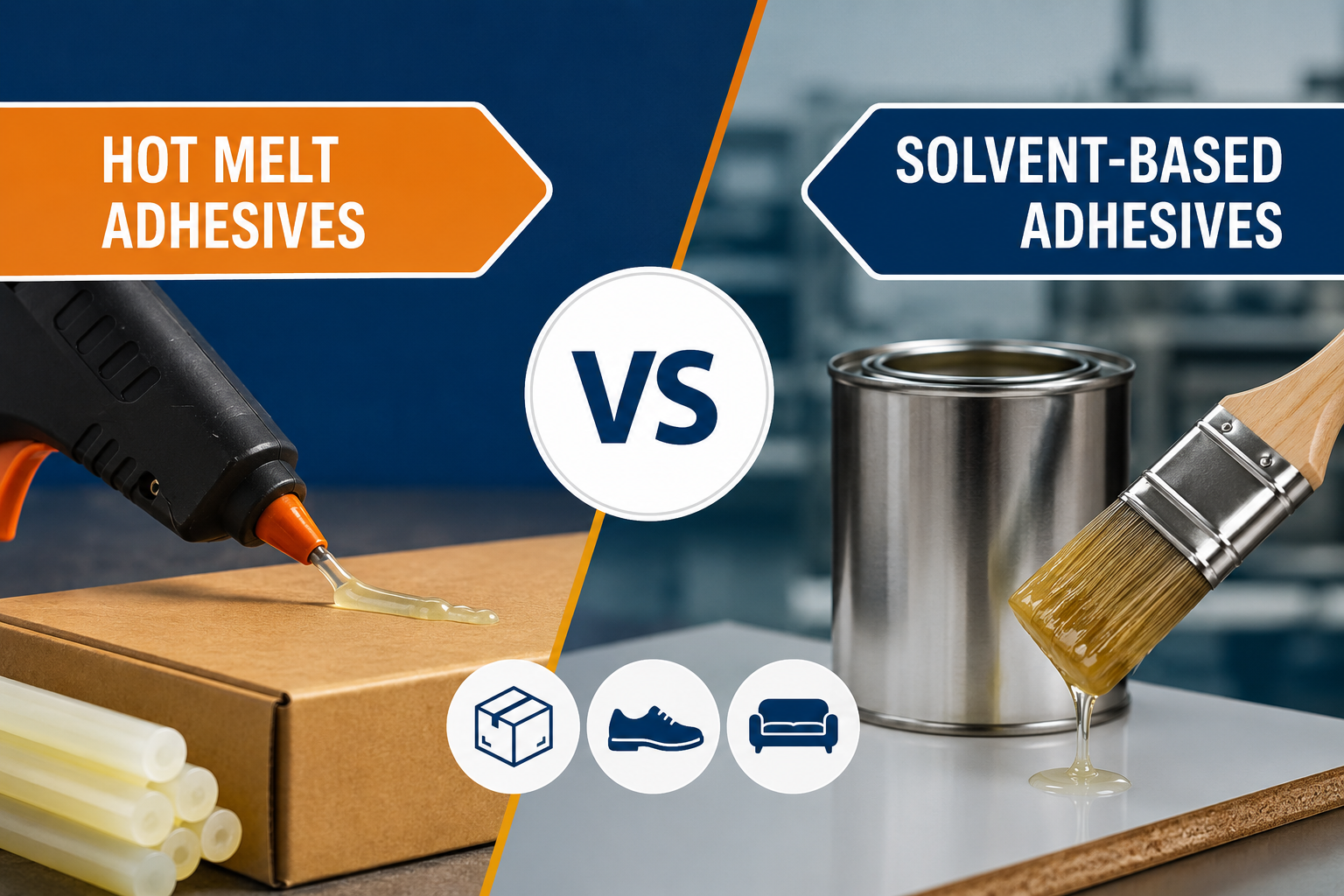
Manufacturers across packaging, printing, and converting industries face one recurring question: should you choose hot melt adhesives or solvent-based adhesives for your application? The answer shapes production speed, bond strength, cost, and environmental compliance. This guide breaks down both adhesive types so you can make a confident, informed decision for your business.
Innokan Technochem manufactures both adhesive categories at its Kundli, Sonipat facility in Haryana, India, and works directly with packaging, paper, and converting industries every day. This hands-on manufacturing experience shapes the practical comparison below.
What Are Hot Melt Adhesives and How Do They Work?
Hot melt adhesives arrive as solid pellets, blocks, or pillows at room temperature. Production lines heat the adhesive until it melts into a liquid, then apply it to a substrate. The adhesive cools and re-solidifies within seconds, creating an instant bond.
This fast-setting behavior makes hot melt adhesives the preferred choice for high-speed packaging lines, case and carton sealing, bookbinding, and product assembly. Because hot melt adhesives contain no solvents, they release zero VOCs (volatile organic compounds) during application, which keeps factory air quality cleaner and supports regulatory compliance.
Hot melt adhesives also store easily, since they don’t evaporate, dry out, or require special ventilation during storage. Manufacturers running multi-shift operations value this because it reduces material waste and minimizes downtime caused by adhesive degradation.
What Are Solvent-Based Adhesives and Where Do They Excel?
Solvent-based adhesives dissolve a polymer in an organic solvent carrier. Once applied, the solvent evaporates, leaving behind a strong, flexible adhesive film. This evaporation process gives solvent-based adhesives excellent penetration into porous and non-porous substrates alike, including foils, films, and laminates.
Solvent-based adhesives typically deliver superior heat resistance and long-term bond durability compared to many hot melt formulations. Industries that demand high-performance lamination, such as flexible packaging, decorative laminates, and specialty labeling, often rely on solvent-based adhesives because the bond holds up under temperature fluctuations and mechanical stress.
The trade-off is that solvent-based adhesives require proper ventilation and VOC management during application, since the evaporating solvent carries emissions that facilities must control through extraction systems or compliant handling protocols.
Bond Strength Comparison: Hot Melt vs Solvent-Based Adhesives
Bond strength depends heavily on the substrate and end-use environment, not just the adhesive category. Hot melt adhesives create strong initial bonds almost instantly, which suits applications where speed matters more than long-term flexibility, such as case sealing or carton closing.
Solvent-based adhesives generally outperform hot melts in applications requiring resistance to heat, humidity, or chemical exposure over extended periods. Flexible packaging that holds food products or industrial laminates exposed to outdoor conditions often performs better with a solvent-based formulation because the adhesive film resists softening or degrading.
Production Speed and Equipment Requirements
Hot melt adhesives integrate directly into high-speed automated lines because they don’t need a drying or curing tunnel. The adhesive sets the moment it cools, which shortens production cycles and increases throughput for case erecting, carton sealing, and packaging assembly.
Solvent-based adhesives require dedicated drying ovens or extended dwell time to allow solvent evaporation before the bond reaches full strength. This adds a processing step, but it also allows manufacturers to fine-tune coating weight and achieve precise adhesive distribution across wide-format laminating equipment.
Environmental Impact and Regulatory Compliance
Sustainability considerations increasingly drive adhesive selection across packaging and converting industries. Hot melt adhesives produce no VOC emissions during application, which simplifies compliance with air quality regulations and reduces the need for costly extraction systems.
Solvent-based adhesives carry a heavier environmental footprint due to solvent evaporation, though responsible manufacturers mitigate this through solvent recovery systems, low-VOC formulations, and strict handling protocols.
Companies pursuing aggressive sustainability goals often transition toward hot melt or water-based alternatives wherever the application allows.
Choosing the Right Adhesive for Your Application
The right adhesive choice depends on five factors: substrate type, required bond strength, production speed, environmental compliance targets, and total operating cost. Packaging operations prioritizing speed and clean air compliance typically benefit most from hot melt adhesives. Lamination and labeling operations requiring superior heat and chemical resistance often perform better with solvent-based formulations.
Working with an experienced adhesive manufacturer helps you test both formulations against your actual production conditions rather than relying on generic specifications. Innokan’s R&D team formulates custom adhesive solutions calibrated to specific substrates, line speeds, and compliance requirements, ensuring you get measurable performance rather than guesswork.
Partner with a Trusted Adhesive Manufacturer
Choosing between hot melt and solvent-based adhesives doesn’t have to be a guessing game. Innokan Technochem combines sustainable chemical manufacturing with deep technical expertise to help packaging, printing, and converting businesses select and formulate the right adhesive for their exact application. Contact Innokan’s team today to request a technical consultation or sample evaluation tailored to your production line.
Frequently Asked Questions (FAQs)
Which adhesive type sets faster: hot melt or solvent-based?
Hot melt adhesives set significantly faster because they solidify through cooling rather than evaporation. Solvent-based adhesives need time for the solvent to evaporate before the bond reaches full strength, making hot melt the better choice for high-speed packaging lines.
Are hot melt adhesives more environmentally friendly than solvent-based adhesives?
Yes, hot melt adhesives release no VOCs during application since they contain no solvent carrier. Solvent-based adhesives require proper ventilation and solvent management to control emissions, making hot melt the lower-impact option for most facilities.
Can solvent-based adhesives bond non-porous materials better than hot melt adhesives?
Solvent-based adhesives generally penetrate non-porous substrates like foils and films more effectively, creating durable bonds that resist heat and chemical exposure. This makes them a strong choice for flexible packaging and specialty lamination.
Do hot melt adhesives require special storage conditions?
Hot melt adhesives store easily at room temperature without evaporating or degrading, unlike solvent-based adhesives that need sealed, ventilated storage to prevent solvent loss and maintain consistent viscosity.
Which adhesive type costs less to operate long-term?
Hot melt adhesives often reduce long-term operating costs because they require no drying equipment, ventilation systems, or solvent recovery infrastructure, lowering both energy use and compliance overhead compared to solvent-based systems.
How Does Innokan Help Businesses Choose Between Hot Melt and Solvent-Based Adhesives?
Innokan’s technical team evaluates your substrate, production speed, and compliance requirements, then recommends and formulates a custom adhesive solution. This consultative approach ensures the chosen adhesive performs reliably under your real production conditions rather than generic lab assumptions.