
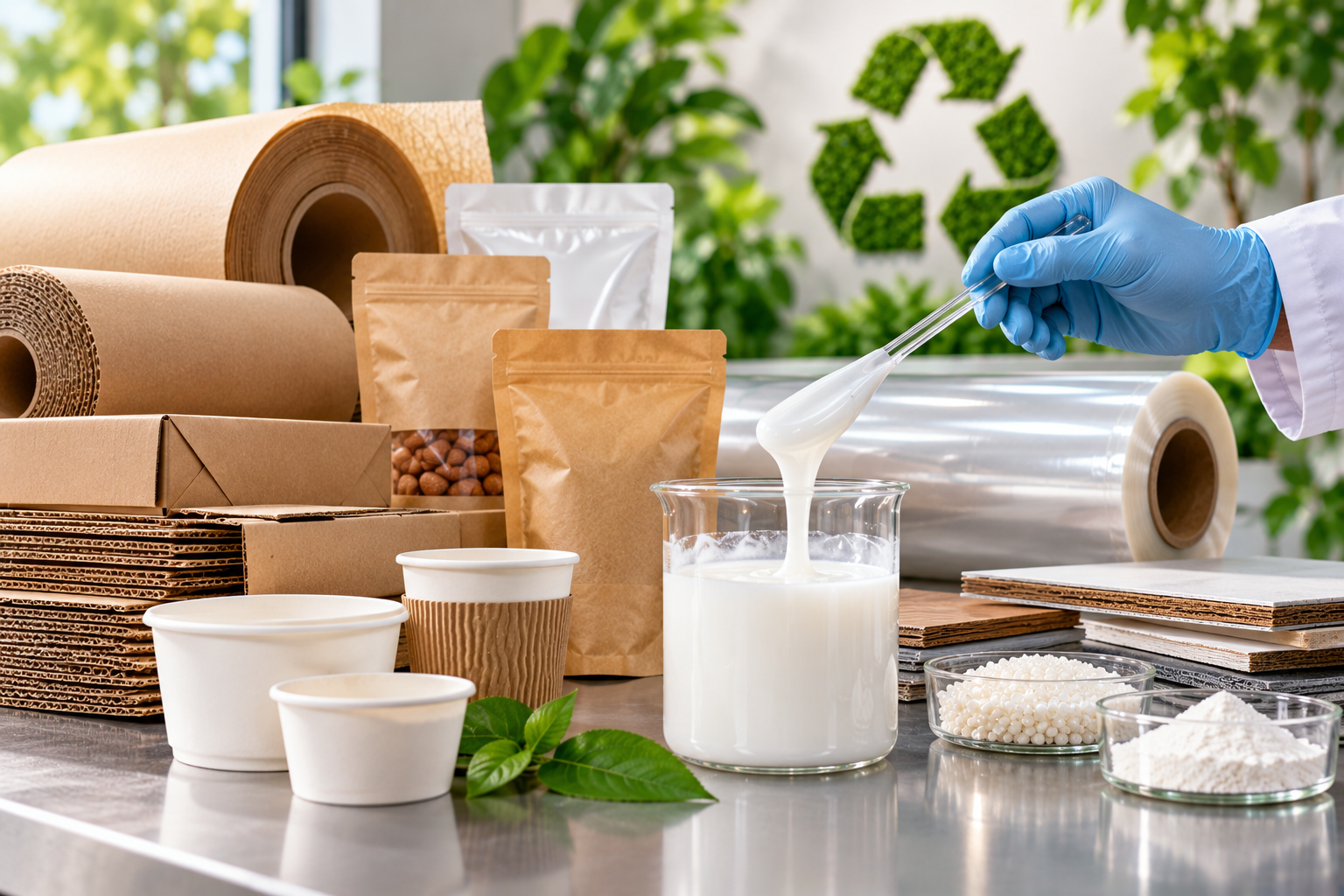
Sustainable water-based adhesives can reduce solvent emissions at the point of use, but they are not automatically green. Their real impact depends on formulation, drying energy, the substrates they bond and what happens to the package or product at end of life. A water-based adhesive that fails in the field, or that blocks paper recycling, can cost more environmentally than a solvent-based one that works.
This article gives sustainability managers, packaging converters and buyers a balanced way to judge the trade-offs. It covers how these adhesives work, where they perform well, where they struggle and which documents to request. It also explains how Innokan Technochem approaches water-based formulation.
What Water-Based Adhesives Are and How They Bond
A water-based adhesive carries its polymer in water. After application, water leaves by absorption into the substrate and by evaporation, and the polymer particles merge into a continuous film that holds the surfaces together.
Innokan’s water-based range is built on polyvinyl acetate and acrylic polymers, with natural binders such as starch and casein. Formulators add plasticizers, crosslinkers and wetting agents to tune flexibility, water resistance and adhesion on low-energy surfaces. Because the water must escape, these adhesives work best where at least one surface is porous, such as paper or board.
Sustainable Water-Based Adhesives Compared With Solvent-Based Systems
The comparison between water-based vs solvent-based adhesives turns on four points.
VOCs. The US Environmental Protection Agency defines VOCs as organic compounds that evaporate readily at normal indoor conditions, and it notes that some can affect health. Solvent-based adhesives release their solvents as they dry. Innokan’s solvent-based page states that its products emit VOCs and need ventilation. Water-based adhesives use water as the main carrier, so solvent emissions are usually lower.
Drying. Solvent systems dry fast. Water-based systems dry more slowly, particularly on non-porous surfaces, and may need heat-assisted drying, as Innokan’s page notes.
Substrates. Solvent-based adhesives suit low-energy plastics and metals. Water-based adhesives suit paper, board and many laminates.
Moisture sensitivity. Water-based bonds can be more sensitive to humidity unless crosslinkers or other additives improve water resistance.
Neither family wins everywhere. The better choice is the one that meets the performance requirement with the lowest total impact.
Where Water-Based Adhesives Perform Well
Innokan lists folding cartons, envelopes, paper labelling, bookbinding and laminating of paper, film and board among its verified applications. Innokan also lists interior and lightweight construction materials, label bonding for paint cans and drums, and laminating for specialty papers and composites.
These uses share a pattern. Paper and board absorb water quickly, which speeds drying and supports production speed. Where a line runs very fast or a non-porous substrate is involved, confirm drying behaviour in a trial. A formulation that suits a carton line may not suit a film laminating line.
Drying Energy and Production Speed in Practice
Drying is where many sustainability claims meet reality. Because water must leave the glue line, a slow line may need heated air, longer tunnels or reduced speed. That uses energy and floor space, which can offset part of the emission benefit.
Production managers can reduce the penalty. Apply the lowest coat weight that still gives fibre tear, ask the supplier about faster-setting grades and check whether your existing dryers already have spare capacity. Measure energy per thousand packs before and after a switch. That single figure often tells you more than a generic claim about eco-friendliness.
What “Sustainable” Depends On
Four stages shape the environmental result.
Formulation. Raw materials matter. Natural binders such as starch and casein come from renewable sources, but renewable does not mean lower impact in every case. Additives, preservatives and crosslinkers also affect safety and disposal, so review the safety data sheet instead of assuming a water-based product is harmless.
Manufacturing. Energy use, water use, waste handling and batch yield all add to the footprint. Ask suppliers how they measure these.
Application. Drying uses energy, and coat weight decides how much adhesive each pack carries. A formulation that bonds well at lower coat weight can reduce both material use and drying load.
End of life. Paper recycling mills dislike adhesive residues that break into sticky particles, often called stickies. INGEDE Method 12, used in European paper recycling assessment, measures how well adhesive applications can be removed during pulping. Research from the US Forest Products Laboratory on pressure-sensitive adhesives found that how water-based adhesive films fragment during repulping is linked to their water resistance. That creates a real tension: improving water resistance can help in humid service but may change recycling behaviour. That research covers pressure-sensitive adhesives, so carton and laminating adhesives need their own testing.
The Limits of Water-Based Adhesives
Honest sustainability work includes the downsides. Water-based adhesives can be slower to dry, more sensitive to humidity and more demanding on drying equipment. Some products need protection from freezing in storage. Some will not bond well to low-energy plastics without a suitable formulation. And “low VOC” is not the same as “non-toxic” or “recyclable”. Claims like those need data for the exact product.
Reading Sustainability Claims Carefully
Marketing language around adhesives is often broader than the evidence. Terms such as eco-friendly, green or safe rarely say which impact they measure. Ask which indicator the claim covers: VOC content, renewable carbon, energy use or recyclability. Then ask for the test or calculation behind it.
Also remember that one improvement can create another problem. A bio-based binder may need more preservative. A more water-resistant grade may help in humid storage but behave differently in a recycling mill. Good suppliers explain these trade-offs openly.
How to Evaluate Technical Performance and Environmental Documentation
Judge performance first, because an adhesive that fails creates waste. Run fibre-tear or peel tests on your actual board, film or laminate. Check open time, set time, bond strength after humidity or cold storage and machine runnability at your line speed.
Then review the environmental documentation. Ask for the safety data sheet, VOC information for the exact grade and any recyclability or repulping test results relevant to your product. If the adhesive touches food packaging, ask for the declarations your market requires. Do not accept a general statement as a substitute for product-specific evidence.
Questions to Ask a Water-Based Adhesive Supplier
Use these questions at the shortlisting stage:
- Which substrates and applications has this grade been tested on?
- What are the drying and set times at my line speed and conditions?
- What is the VOC content or emission data for this exact grade?
- Do you have repulpability or recyclability test results, and which method did they use?
- Which additives or preservatives does the grade contain?
- How do you control batch consistency, and will you notify me of raw material changes?
- Can you run a pre-application trial and support process optimization?
A supplier who answers these with data is easier to trust than one who answers with slogans.
How Innokan Technochem Approaches Water-Based Adhesives
Innokan Technochem manufactures water-based adhesives at its facility in Kundli, Sonipat, Haryana. Its water-based adhesives page lists adjustable tack level and drying time, additive packages for water resistance and adhesion, and support through pre-application trials, process optimization and troubleshooting.
Innokan’s research and development page states a focus on reducing VOCs, using renewable resources and minimizing waste, supported by stress testing, environmental impact analysis and batch quality control. It also describes recent work on water-based adhesives with reduced VOC emissions. Where a project involves non-porous surfaces or high moisture, Innokan’s solvent-based adhesives page shows the alternative route, so the comparison stays honest. Request product-specific documentation for any grade you plan to use.
Making a Balanced Choice
Sustainable water-based adhesives deliver the most value when they meet the bonding requirement first and the environmental goal second. Test performance on real substrates, ask for grade-specific documents and consider drying energy and end-of-life behaviour alongside VOCs.
To explore suitable adhesive solutions and discuss your technical requirements, visit Innokan’s adhesives portfolio or email info@innokan.com with your substrates, line speed and environmental targets.
Reference Table
| Resource or Topic | Why It Is Relevant | Verified URL |
| Choosing the Right Water-Based Adhesive Manufacturers for Paper and Flexible Packaging | Covers how to shortlist manufacturers, which complements this article’s focus on sustainability trade-offs | https://innokan.com/blog/choosing-the-right-water-based-adhesive-manufacturers-for-paper-and-flexible-packaging/ |
| Innokan FAQ | Summarizes how Innokan describes its sustainability approach across adhesives, inks and coatings | https://innokan.com/faq/ |
| Contact Innokan | Official route to request samples, documentation and a technical discussion | https://innokan.com/contact-us/ |
FAQs
What are water-based adhesives and how do they work?
They carry the adhesive polymer in water, which leaves by absorption and evaporation so the polymer forms a bonding film. They suit porous substrates such as paper and board best.
How do water-based adhesives support sustainability?
They usually emit fewer VOCs than solvent-based adhesives and can use renewable binders such as starch. The overall benefit still depends on formulation, drying energy and end-of-life behaviour.
Are water-based adhesives always non-toxic or recyclable?
No, because additives, preservatives and polymers vary by product. Check the safety data sheet and request recyclability test results for the exact grade.
What is the difference between water-based and solvent-based adhesives?
Water-based adhesives use water as the carrier, emit fewer VOCs and dry more slowly. Solvent-based adhesives dry quickly and suit low-energy substrates but emit VOCs.
Where are water-based adhesives commonly used?
Common uses include folding cartons, envelopes, labelling, bookbinding and laminating of paper, film and board. Innokan also lists label bonding and interior or lightweight construction uses.
Why do water-based adhesives dry more slowly?
The water must be absorbed into the substrate or evaporate before the film forms, which takes longer on non-porous surfaces. Heat-assisted drying can speed the process.
How can I test whether an adhesive affects paper recycling?
Ask the supplier for repulping or stickies test results, such as those based on INGEDE Method 12. Results apply to the tested construction, so repeat testing for your own pack.
What should I ask a water-based adhesive supplier before buying?
Ask about tested substrates, drying behaviour, VOC data, additives, recyclability results, batch control and trial support. Innokan offers pre-application trials and process support.