
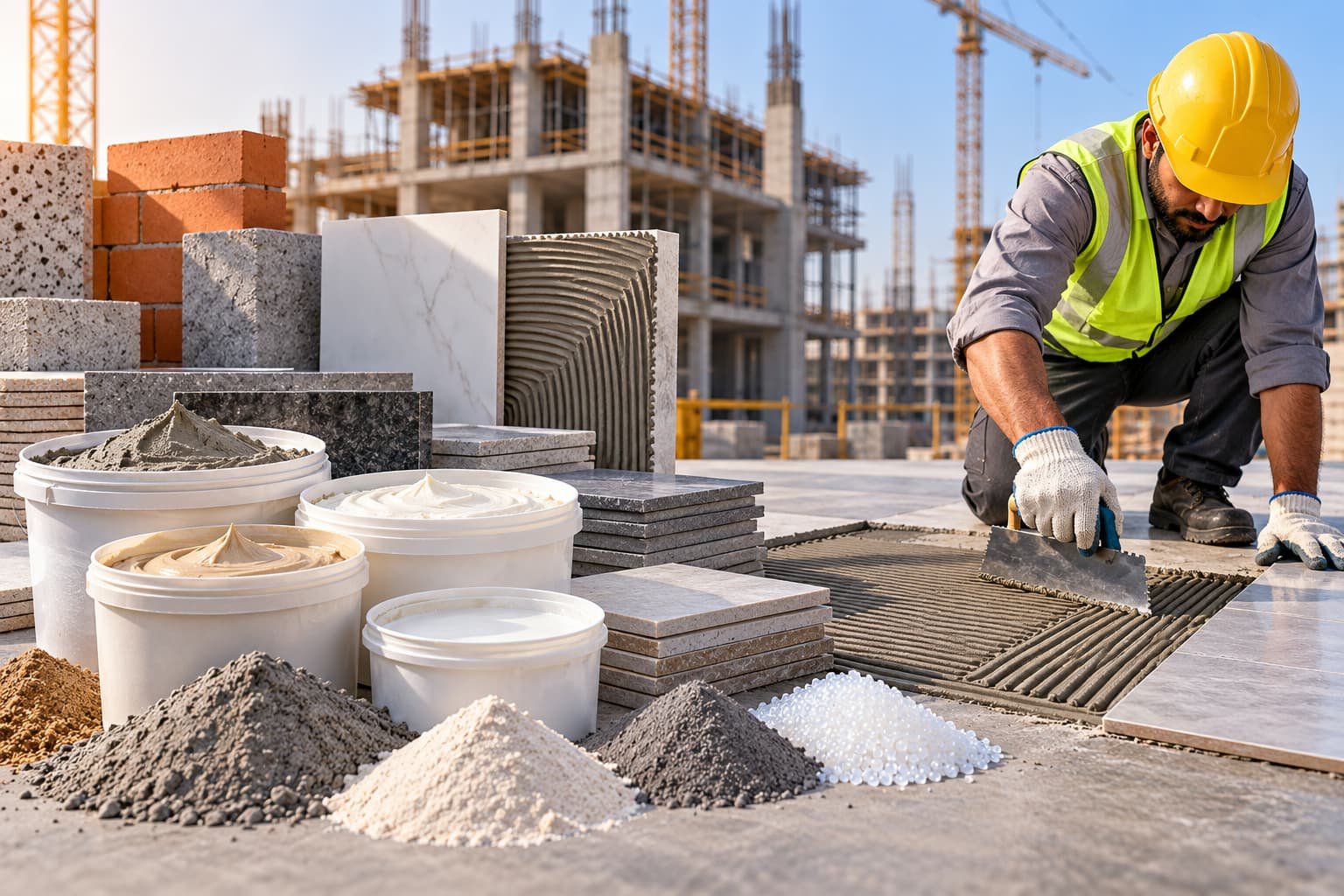
The right adhesives for construction chemicals are the ones matched to your substrates, your service conditions and your production or site process. No single formulation suits every building material. A bond that holds on dry plywood indoors can fail on damp concrete outdoors, and a fast-drying system that works in a ventilated factory may be a poor choice in an enclosed space.
This guide gives manufacturers, procurement teams and quality managers a practical way to compare options. It covers substrate checks, performance factors, water-based and solvent-based systems, VOC rules, common mistakes and supplier questions. It also explains where Innokan Technochem’s adhesive range may fit.
What Construction Chemical Adhesives Do and Where They Are Used
Construction chemical adhesives join building materials during product manufacture and during installation. Typical examples include laminating facings onto insulation or panel cores, bonding wood-based boards, attaching metal or plastic profiles and assembling lightweight interior components.
Scope matters here. Cement-based tile adhesives follow their own Indian standard, IS 15477:2019, which covers adhesives for ceramic, mosaic and stone tiles. Innokan’s published adhesive pages describe hot melt, water-based and solvent-based systems instead. Innokan lists solvent-based adhesives for construction panels and industrial assembly, and water-based adhesives for interior and lightweight construction materials. Treat those lines as starting points for a technical conversation, not as a promise for every material.
Start With the Substrate and the Surface
Substrate compatibility causes more bond failures than low adhesive strength does. Check each material before you compare products.
Concrete and cement boards are porous, alkaline and often damp. Dust and curing compounds weaken any bond. Wood and wood-based panels move with humidity, so the adhesive must tolerate that movement. Metals need clean, oil-free surfaces, and oxidation can undermine adhesion over time. Some foam insulation can be attacked by strong solvents, so test before you commit. Always trial the adhesive on a small piece of the real material.
Surface preparation is part of the specification. Clean, dry, sound surfaces give the adhesive a fair chance. Low-energy plastics may need surface treatment or a formulation designed for them. Innokan’s solvent-based adhesives page lists polyethylene, polypropylene and metals among the substrates those systems are designed to bond.
Performance Factors That Decide Long-Term Bond Quality
Five factors matter most in construction-related bonding.
Bond strength. Ask what load the joint will carry. Static load, peel and shear can behave differently, so a single headline number rarely tells the full story.
Curing and open time. Open time is how long you can position parts after applying the adhesive. Set time and full cure come later. Fast set suits factory lines, while longer open time helps with large panels.
Moisture exposure. Water can weaken some bonds, especially in humid or exterior conditions. Request water-resistance data that matches your real exposure.
Temperature variation. Building materials expand and contract. Repeated heating and cooling can open joints if the adhesive is too rigid or softens at high temperature.
Durability. Long-term performance depends on all four factors acting together over years. Accelerated ageing tests on your own assemblies give the best early warning.
Water-Based and Solvent-Based Adhesives for Construction Work
Water-based adhesives use water as the carrier. Innokan’s range uses polyvinyl acetate, acrylics and natural binders such as starch and casein. These systems suit porous materials and interior uses, and they emit fewer VOCs. They dry more slowly than hot melt, especially on non-porous surfaces, and moisture resistance depends on the formulation. Many water-based products also need protection from freezing, so confirm storage limits with your supplier.
Solvent-based adhesives use organic solvents such as toluene, acetone and alcohols, combined with polyurethane or acrylic resins. Innokan’s page describes rapid drying, strong adhesion on low-energy substrates and good moisture and chemical resistance. The trade-off is VOC emission, which calls for ventilation and strict handling practices.
Hot melt adhesives offer a third route for fast-setting assembly on suitable substrates. Choose between these families by substrate, exposure and process, not by habit.
VOCs, Sustainability and Workplace Requirements
The US Environmental Protection Agency describes VOCs as organic compounds that evaporate readily at normal indoor temperature and pressure, and it notes that some can have short-term or long-term health effects. For construction products, adhesive choice therefore becomes a workplace and indoor-air question.
Solvent-based systems release VOCs as they dry, so plan for ventilation, storage rules and operator protection. Water-based systems usually lower solvent emissions, but you still need to review the safety data sheet because additives vary. Green building programmes may ask for emission documentation on products used in a project. Requirements differ by programme and region, so ask your supplier what test data exists before you specify a product.
Sustainability also includes durability. A bond that lasts the life of a building avoids repair, waste and rework.
A Five-Step Selection Process
A simple process keeps construction adhesive selection objective. First, define the joint: substrates, load, exposure, service life and the process that applies the adhesive. Second, shortlist two or three adhesive families that suit those conditions. Third, request data sheets and samples from each supplier. Fourth, test the samples on real materials under realistic heat, moisture and load. Fifth, freeze the specification, including incoming batch checks, so later orders match the approved product.
A Worked Example of the Process
Imagine a panel manufacturer laminating a thin facing onto a lightweight board for interior partitions. This is a hypothetical illustration, not a customer case. The joint carries little load but must stay flat through humid monsoon months. The board is porous, so a water-based adhesive could dry well and keep solvent emissions low in the plant. The team would still test open time, board warping and bond strength after humidity exposure.
If the facing were a low-energy plastic or a metal sheet, the same team might shortlist a solvent-based or hot melt system and check ventilation needs. The lesson is the sequence: define the joint, shortlist by chemistry, then let test results decide.
Common Mistakes When Choosing Construction Adhesives
Most selection problems repeat the same few patterns:
- Choosing on price or datasheet strength alone.
- Skipping trials on the real substrates.
- Ignoring surface preparation.
- Testing at room temperature when the product will see heat, cold or damp.
- Assuming one water-based or solvent-based product works everywhere.
- Changing supplier or batch without retesting.
Each of these is cheap to avoid before purchase and expensive to fix after installation.
How to Evaluate Adhesive Manufacturers and Suppliers
A reliable supplier gives evidence, not just claims. Ask for the technical data sheet, the safety data sheet and typical test results on substrates like yours. Request samples and test them under your own conditions, including moisture and temperature cycles.
Check batch consistency. Ask how the manufacturer controls quality from batch to batch and whether a certificate of analysis ships with each lot. Confirm that you will be told about raw material changes before they reach your line.
Finally, judge the technical support. Can the team run trials, troubleshoot application problems and adjust formulations? A supplier who answers these questions clearly will usually perform better after the sale too. Also ask how the supplier handles complaints. A written process for investigating a failed batch tells you more about reliability than any brochure does.
Where Innokan Technochem Fits
Innokan Technochem manufactures adhesives at its facility in Kundli, Sonipat, Haryana. The verified portfolio covers hot melt, water-based and solvent-based systems. Its solvent-based adhesives page positions those products for demanding substrates, while its water-based adhesives page describes adjustable tack and drying time, pre-application trials and process support.
Innokan’s research and development page describes stress testing, environmental impact analysis and quality control aimed at consistent batches, along with work to reduce VOCs. Those capabilities suit buyers who want a formulation discussion rather than an off-the-shelf pick. Innokan has not published data for every construction substrate, so share your requirements early and ask for trial samples.
Choose Adhesives for Construction Chemicals With Evidence
Good adhesives for construction chemicals start with a clear brief: substrates, loads, exposure, process and workplace limits. Test candidates on real materials, review the documentation and judge the supplier’s technical depth before you scale up.
If you want to discuss application-specific bonding requirements, contact Innokan Technochem or write to info@innokan.com with your substrates, service conditions and production process.
Reference Table
| Resource or Topic | Why It Is Relevant | Verified URL |
| Innokan adhesives portfolio | Gives an overview of the hot melt, water-based and solvent-based systems you can compare during shortlisting | https://innokan.com/adhesives/ |
| Adhesives for Construction Chemicals: Build Stronger Projects With Innokan Today | Existing Innokan article that covers solvent-based systems and construction durability from a product viewpoint | https://innokan.com/blog/adhesives-for-construction-chemicals-build-stronger-projects-with-innokan-today/ |
| Innokan FAQ | Answers general questions about industries served, sustainability claims and how to select an adhesive | https://innokan.com/faq/ |
FAQs
What are adhesives for construction chemicals used for?
Answer: They bond building materials during product manufacture and installation, such as panel laminates, wood-based boards, metal facings and lightweight interior components. The right type depends on the substrates and service conditions.
How do I choose an adhesive for concrete, wood or metal?
Answer: Start with the substrate’s porosity, moisture and surface cleanliness, then match the adhesive chemistry and test it on the real material. Surface preparation affects the result as much as the adhesive does.
What is the difference between water-based and solvent-based construction adhesives?
Answer: Water-based adhesives use water as the carrier, emit fewer VOCs and dry more slowly. Solvent-based adhesives dry quickly and suit demanding substrates but emit VOCs and need ventilation.
How does moisture affect adhesive bonds in construction?
Answer: Moisture can weaken some bonds, soften certain polymers and change how substrates such as wood and concrete behave. Ask for water-resistance data that matches your exposure.
Do temperature changes affect construction adhesives?
Answer: Yes, because building materials expand and contract and some adhesives soften in heat or stiffen in cold. Test the bond across the temperature range of the intended use.
What documents should I request from an adhesive supplier?
Answer: Ask for the technical data sheet, safety data sheet, test data on similar substrates and batch quality documentation. Request VOC information if your project needs emission documentation.
Does Innokan supply cement-based tile adhesives covered by IS 15477?
Answer: Innokan’s published adhesive pages list hot melt, water-based and solvent-based systems and do not list cement-based tile adhesives. Contact the team to discuss any specific requirement.
Why should I run trials before buying adhesives in bulk?
Answer: Trials on real substrates and conditions reveal bond, curing and compatibility problems before they reach production or site. They also give you a baseline for later batch checks.