
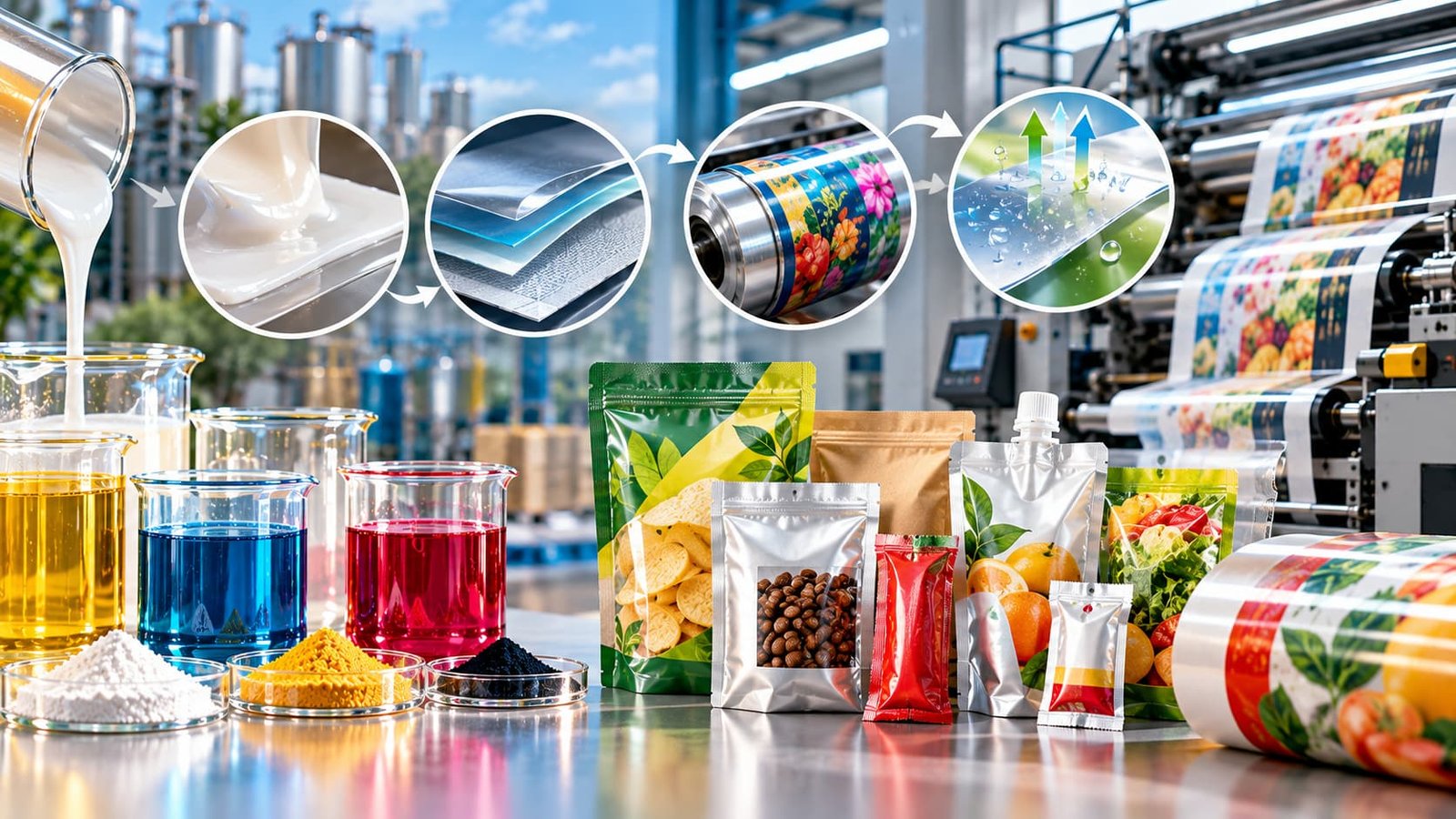
A packaging structure can fail long before the consumer sees an obvious defect. A weak adhesive interface can lead to delamination. Poor sealing can allow leakage. An unsuitable coating can reduce surface protection or affect print appearance.
This is why advanced coatings and adhesives play a critical role in packaging and printing.
They are not simply supporting materials. They influence how different layers bond, how surfaces behave and how the finished package performs under real-world conditions.
Adhesion Is the Foundation
Adhesion describes the interaction between two different materials at their interface.
In packaging, this can mean bonding:
- Film to film
- Film to foil
- Paper to board
- Film to paper
- Coated surfaces to substrates
The adhesive must interact with the surface sufficiently to develop the required bond.
Several variables influence this:
- Surface energy
- Cleanliness
- Surface treatment
- Adhesive chemistry
- Coat weight
- Drying
- Temperature
- Humidity
A formulation that performs well on one substrate may not behave identically on another.
Why Substrate Compatibility Matters
Packaging manufacturers increasingly work with combinations of materials that have different surface characteristics.
Polyolefin films can present adhesion challenges because of their relatively low surface energy. Metallised films introduce another set of interface considerations. Paper and board are porous and can absorb components from a formulation.
This makes substrate evaluation essential.
Innokan’s solvent-based adhesive systems are described for applications involving plastics, metals, laminates and flexible packaging structures.
Water-based adhesives are positioned for paper, cardboard, labels and selected laminating applications.
Heat Seal Coatings Create Functional Sealing Surfaces
A package needs more than structural bonding.
It also needs to close.
Heat seal coatings can create sealable surfaces that activate under appropriate temperature and pressure. Their performance can influence package integrity, leakage resistance and production efficiency.
Innokan identifies several heat seal coating categories, including thermoplastic, water-based, solvent-based and acrylate-based systems.
The correct system depends on the substrate and sealing requirements.
Temperature
The coating must activate within the available sealing window.
Pressure
Adequate pressure is required to create contact between the surfaces.
Dwell Time
The seal must receive sufficient heat and pressure.
Contamination
Food particles, dust or other contaminants can reduce seal quality.
Substrate
The coating must be compatible with the actual packaging material.
UV Coatings Add Surface Protection
UV coatings cure when exposed to ultraviolet radiation.
They can provide properties such as gloss, surface protection, scratch resistance and chemical resistance depending on the formulation.
Innokan’s UV coating page describes UV-curable coatings for packaging, labels and specialty print finishing, with characteristics including fast curing, gloss and surface protection.
The production benefit is straightforward: curing can occur rapidly when the coating and curing system are properly matched.
However, curing depends on factors such as coating thickness, UV intensity, exposure and formulation.
Release Coatings Solve a Different Problem
Not every coating is designed to make a surface more adhesive.
Release coatings are designed to provide controlled separation.
They are useful in applications such as:
- Label liners
- Protective films
- Transfer films
- Graphic films
Innokan describes its release coating technology around PMMA-based systems applied to PET films, with controlled release and optical clarity as relevant properties.
The required release force depends on the adhesive, substrate and application.
Barrier Performance Requires More Than One Variable
Barrier properties can involve protection against:
- Moisture
- Oxygen
- Grease
- Chemicals
- External contamination
A coating may contribute to barrier performance, but the final barrier behaviour depends on the complete packaging structure.
Film properties, coating continuity, defects, adhesive interfaces and processing conditions can all influence the result.
This is why packaging engineers should test the finished structure rather than relying only on individual component specifications.
How Coatings Influence Printing
Coatings can also change how a printed surface looks and behaves.
A suitable coating can protect graphics from:
- Scratching
- Scuffing
- Moisture
- Chemical exposure
- Handling damage
UV coatings are particularly relevant to premium packaging and labels where appearance and surface durability are important.
The coating must still be compatible with the ink underneath.
Production Efficiency Is Part of Performance
Packaging performance is not limited to the finished package.
A formulation that requires excessive drying time may slow the line. A coating that requires unusual curing conditions may need equipment modifications.
Production teams should therefore examine:
- Line speed
- Drying capacity
- Curing system
- Coat weight
- Application method
- Temperature
- Environmental conditions
- Quality-control requirements
Innokan’s R&D information highlights testing and quality assurance as part of its development approach.
Quality Control Should Follow the Application
Different applications require different testing.
For adhesives, useful evaluations may include peel strength, bond development and ageing.
For coatings, manufacturers may evaluate:
- Coating uniformity
- Seal strength
- Release force
- Gloss
- Scratch resistance
- Chemical resistance
For printing systems, relevant tests may include:
- Print adhesion
- Colour consistency
- Rub resistance
- Drying or curing
- Surface compatibility
The test method should reflect the actual use case.
A Better Way to Select an Adhesive or Coating
Instead of beginning with the product category, begin with the application.
Ask:
What Materials Are Being Joined or Coated?
Identify the film, paper, foil, board, coating and other materials involved in the final structure.
What Production Process Will Be Used?
Consider the printing, laminating, coating, drying, curing and sealing processes involved.
What Conditions Will the Package Face?
Consider temperature, humidity, moisture, chemicals, abrasion, handling and other relevant conditions.
What Performance Must the Final Package Achieve?
Define requirements for adhesion, sealing, surface protection, appearance, durability and other application-specific properties.
What Sustainability and Regulatory Requirements Apply?
Consider material efficiency, VOC considerations, waste, energy use and applicable regulatory or end-of-life requirements.
This process reduces the risk of selecting a technically attractive but operationally unsuitable material.
How Innokan Can Support the Process
Innokan‘s portfolio includes adhesives, specialty coatings and printing inks, while its R&D operation focuses on formulation development, testing and application-specific innovation.
That combination is relevant for manufacturers dealing with complex packaging structures where the interaction between bonding, printing and surface functionality matters.
Looking for Advanced Coatings and Adhesives?
The right adhesive or coating depends on more than the product category. Substrate compatibility, production conditions, sealing requirements, surface functionality and final-use performance all need to be considered.
Explore Innokan’s adhesives and specialty coating technologies for packaging, printing and other industrial applications.
Explore Adhesives |
Explore Coatings |
Heat Seal Coatings |
UV Coatings |
Release Coatings
Final Takeaway
Advanced coatings and adhesives influence some of the most important properties of modern packaging.
Adhesives create structural connections. Heat seal coatings create functional seals. UV coatings protect and enhance printed surfaces. Release coatings control separation.
The strongest results come when each material is evaluated as part of the complete packaging system.
Frequently Asked Questions About Advanced Coatings and Adhesives
What are advanced coatings used for in packaging?
They can provide sealing, surface protection, release properties, gloss, durability and other functional characteristics.
What is a heat seal coating?
It creates a sealable surface that bonds under suitable heat and pressure.
Why is adhesive compatibility important?
Poor compatibility between the adhesive and substrate can reduce bond strength and package durability.
What are UV coatings used for?
They can provide fast-curing surface protection, gloss, scratch resistance and chemical resistance.
What is a release coating?
It provides controlled separation between a substrate and an adhesive or transferred material.
Can coatings improve packaging appearance?
Yes. Depending on formulation, coatings can provide gloss, clarity, matte effects or other surface finishes.
What affects heat seal performance?
Temperature, pressure, dwell time, coating properties, substrate and surface cleanliness all matter.
Why should coatings be tested on the finished package?
Final performance depends on interactions between the coating, substrate, ink, adhesive and processing conditions.