
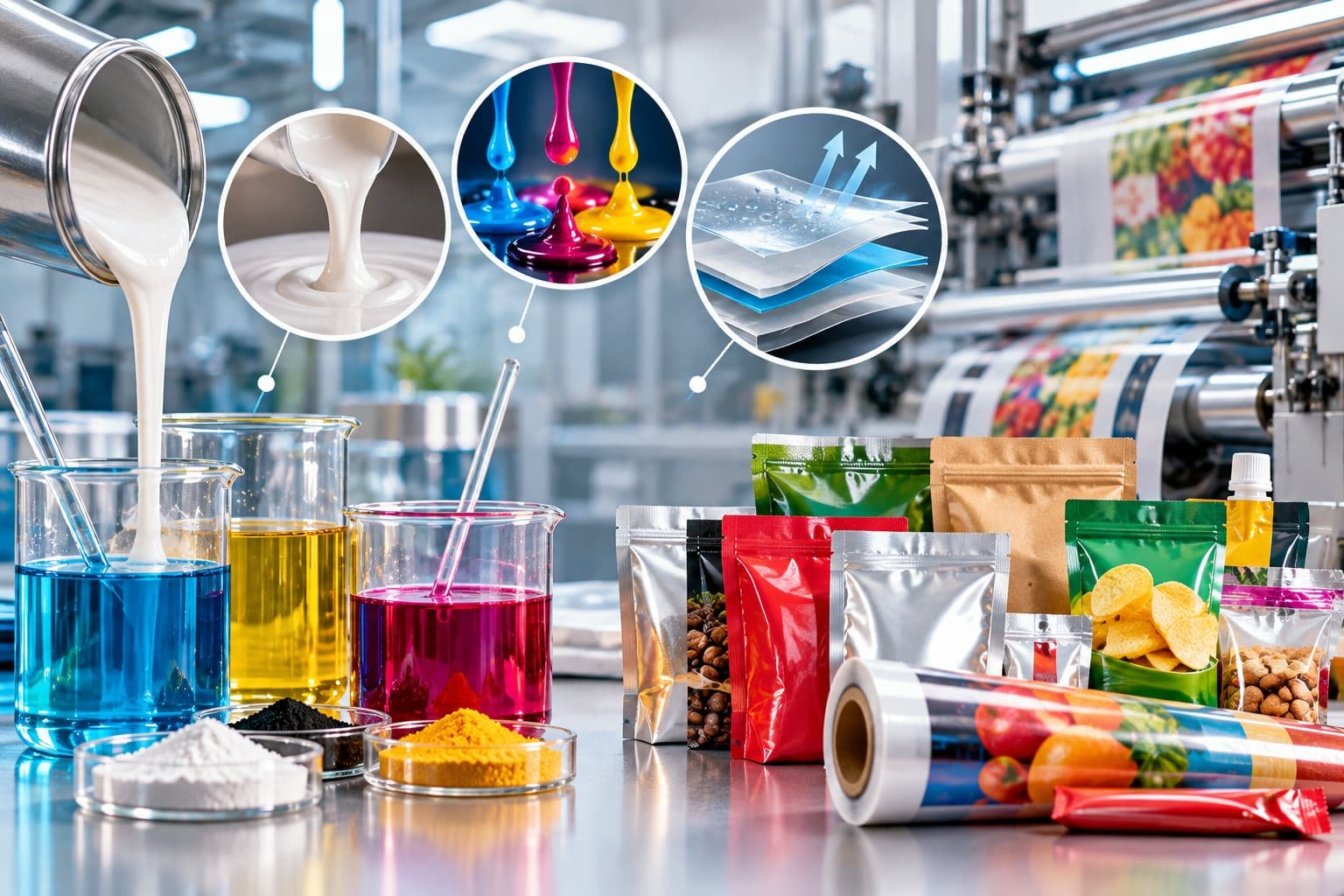
A flexible package can look simple from the outside, but its performance often depends on several carefully engineered chemical layers. Printing ink creates graphics and information. Adhesives hold layers together. Coatings provide functions such as sealing, protection, release or surface modification.
That is why adhesives, inks and coatings should not be evaluated as isolated materials.
A packaging structure can contain multiple films, paper, foil, ink layers, adhesive interfaces and functional coatings. If one layer interacts poorly with another, the final package can experience adhesion loss, print defects, sealing problems or reduced durability.
Understanding the chemistry behind these interactions helps packaging manufacturers make better material and process decisions.
Why Packaging Is More Than a Substrate
A film or paper substrate provides the physical foundation of a package, but the substrate alone rarely delivers every required function.
Modern packaging may need to:
- Display high-quality graphics
- Resist moisture and grease
- Protect printed information
- Bond several materials together
- Form strong seals
- Maintain package integrity
- Survive transportation
- Support opening or resealing
- Provide barrier functionality
- Meet application-specific safety requirements
Chemical layers help create these properties.
Innokan describes its coatings portfolio as covering functions including release, heat sealing and UV protection, while its inks portfolio covers water-based, solvent-based and UV-curable systems.
What Do Adhesives Do?
Adhesives create the interface between two materials.
In flexible packaging, an adhesive may join layers such as films, paper or foil. The adhesive must wet the relevant surfaces, establish sufficient interfacial contact and develop the required bond.
The formulation needs to match the substrates and the production process.
Important variables include:
- Surface energy
- Surface treatment
- Substrate polarity
- Adhesive chemistry
- Coat weight
- Drying or curing
- Temperature
- Line speed
- Humidity
- Required bond strength
Innokan’s adhesive portfolio includes water-based, solvent-based and hot melt technologies.
Water-based adhesives can be particularly relevant for paper, board, labelling and selected laminating applications. Solvent-based systems are used where strong bonding and resistance are required on challenging substrates. Hot melts can offer rapid setting for applications such as carton sealing and assembly.
The correct choice depends on the complete application.
What Do Printing Inks Do?
Ink has two obvious jobs: provide colour and communicate information.
Its technical role is broader.
Ink must transfer correctly from the printing system to the substrate and then dry or cure sufficiently to produce the required film.
A packaging ink may need:
- Consistent colour
- Good print definition
- Substrate adhesion
- Abrasion resistance
- Moisture resistance
- Chemical resistance
- Appropriate drying
- Compatibility with downstream processes
Innokan’s ink portfolio includes water-based, solvent-based and UV-curable systems.
Water-based inks use water as the primary carrier and are commonly suited to paper and board applications. Solvent-based inks are commonly used on non-porous materials because solvent evaporation supports rapid drying. UV-curable inks polymerise when exposed to UV radiation and can provide rapid curing and durability.
What Do Coatings Add?
Coatings are often used to introduce a specific surface property.
Depending on the chemistry, a coating may improve:
- Heat sealing
- Surface protection
- Gloss
- Scratch resistance
- Release behaviour
- Barrier performance
- Chemical resistance
- Visual appearance
Innokan’s coatings portfolio includes release coatings, heat seal coatings and UV coatings.
For example, a heat seal coating can allow a structure to form a secure seal when exposed to the appropriate combination of heat and pressure.
A release coating serves a different purpose. It is designed to provide controlled release between an adhesive and its backing material.
The chemistry must therefore match the intended function.
The Relationship Between Printing and Adhesion
One of the most important considerations in multilayer packaging is the interaction between ink and adhesive.
Suppose a printed film is later laminated to another substrate. The adhesive does not interact only with the film. Depending on the construction, it may interact with the printed surface.
That means ink formulation, surface treatment, drying and adhesive selection can influence one another.
Poor compatibility can contribute to:
- Weak interlayer adhesion
- Ink pick-off
- Delamination
- Appearance defects
- Curl
- Reduced package integrity
This is why laboratory testing should represent the actual printed and laminated structure rather than evaluating every material only in isolation.
Lamination: Where Multiple Variables Meet
Lamination combines layers to create a composite structure.
The process depends on more than adhesive chemistry.
Manufacturers must consider:
- Substrate properties
- Surface treatment
- Ink system
- Adhesive selection
- Adhesive coat weight
- Drying or curing
- Line speed
- Environmental conditions
- Final application
A solvent-based adhesive may be suitable for one film combination but unnecessary for another. A water-based adhesive may work effectively for paper-based structures but require different drying conditions.
Innokan’s solvent-based adhesive solutions address applications including flexible packaging laminates and challenging plastic, metal and laminate substrates.
Heat Sealing Protects Packaging Integrity
A package is not finished when the layers are laminated.
The final structure still needs to form and maintain a reliable seal.
Heat seal coatings can help create bonds between packaging materials under controlled heat and pressure. Innokan identifies thermoplastic, water-based, solvent-based and acrylate-based heat seal systems for different applications.
Seal performance can depend on:
- Activation temperature
- Seal pressure
- Dwell time
- Coating thickness
- Substrate
- Contamination
- Packaging geometry
This explains why the same coating cannot automatically be expected to behave identically across every packaging line.
Surface Treatment Matters
Low-surface-energy materials such as certain polyolefin films can present adhesion challenges.
Surface treatment can modify the surface properties and improve the interaction between the substrate and subsequent layers.
However, surface treatment is only one part of the system.
A packaging manufacturer still needs to evaluate the ink, adhesive or coating against the actual treated substrate.
Packaging Performance Is a System Property
The strongest lesson for packaging buyers is simple: do not evaluate every chemical component separately.
Consider a structure such as:
Film → Ink → Adhesive → Second Film → Heat Seal Layer
The final package depends on how these layers interact.
A technically excellent ink can still create problems if it interferes with lamination. An excellent adhesive can still fail if the substrate is poorly prepared. A good heat seal coating can underperform if the sealing conditions are unsuitable.
System-level testing therefore becomes essential.
A Practical Evaluation Framework
Before approving a new chemical system, packaging manufacturers should ask:
Does It Match the Substrate?
Check film, paper, foil, board and surface treatment.
Does It Match the Printing Process?
Evaluate flexographic, gravure or other relevant printing conditions.
Does It Fit the Production Line?
Consider speed, drying, curing, temperature and equipment.
Does It Meet Final-Use Requirements?
Consider moisture, grease, chemicals, abrasion, temperature and mechanical stress.
Does It Support Sustainability Objectives?
Review VOCs, material consumption, waste, energy requirements and end-of-life considerations.
Where Innokan Can Fit
Innokan provides chemical technologies across adhesives, inks and coatings, allowing manufacturers to consider several connected formulation requirements within one broader chemical portfolio.
Its R&D operation also focuses on testing, formulation development and application-specific chemical innovation.
For packaging teams, this can be useful when the challenge involves interactions between multiple chemical layers rather than one isolated component.
Final Takeaway
High-performance packaging is the result of coordinated material and chemical engineering.
The substrate provides the foundation. Ink delivers graphics and information. Adhesives create structural bonds. Coatings add functions such as sealing, protection or controlled release.
When these components are selected as a complete system, manufacturers can better control adhesion, print quality, sealing and durability.
That systems approach is increasingly important as packaging structures become more specialised and sustainability requirements become more demanding.
Looking for the Right Adhesives, Inks or Coatings?
Choosing individual chemical components is only one part of packaging development. The interaction between substrates, inks, adhesives and coatings can determine the performance of the finished structure.
Explore Innokan’s solutions to identify technologies that match your packaging application, production process and performance requirements.
Explore Adhesives |
Explore Inks |
Explore Coatings |
Explore R&D
Frequently Asked Questions About Packaging Adhesives, Inks and Coatings
Why are adhesives important in packaging?
Adhesives join packaging layers and help maintain structural integrity during handling, storage and use.
What role do inks play in packaging?
Inks provide graphics, product information and branding while also needing suitable adhesion and durability.
What are packaging coatings used for?
Coatings can provide heat sealing, surface protection, release behaviour, gloss and other functional properties.
Can ink affect lamination?
Yes. Ink surface properties, drying and compatibility can influence the adhesive interface.
Why is substrate compatibility important?
Chemical performance depends strongly on how the formulation interacts with the actual film, paper, foil or board surface.
What is a heat seal coating?
It is a functional coating that enables a packaging structure to form a seal under suitable heat and pressure.
Should packaging chemicals be tested together?
Yes. Testing the complete structure can reveal interactions that isolated material testing may miss.
Does Innokan offer multiple packaging chemical technologies?
Yes. Its portfolio includes adhesives, printing inks and specialty coatings for different industrial applications.