
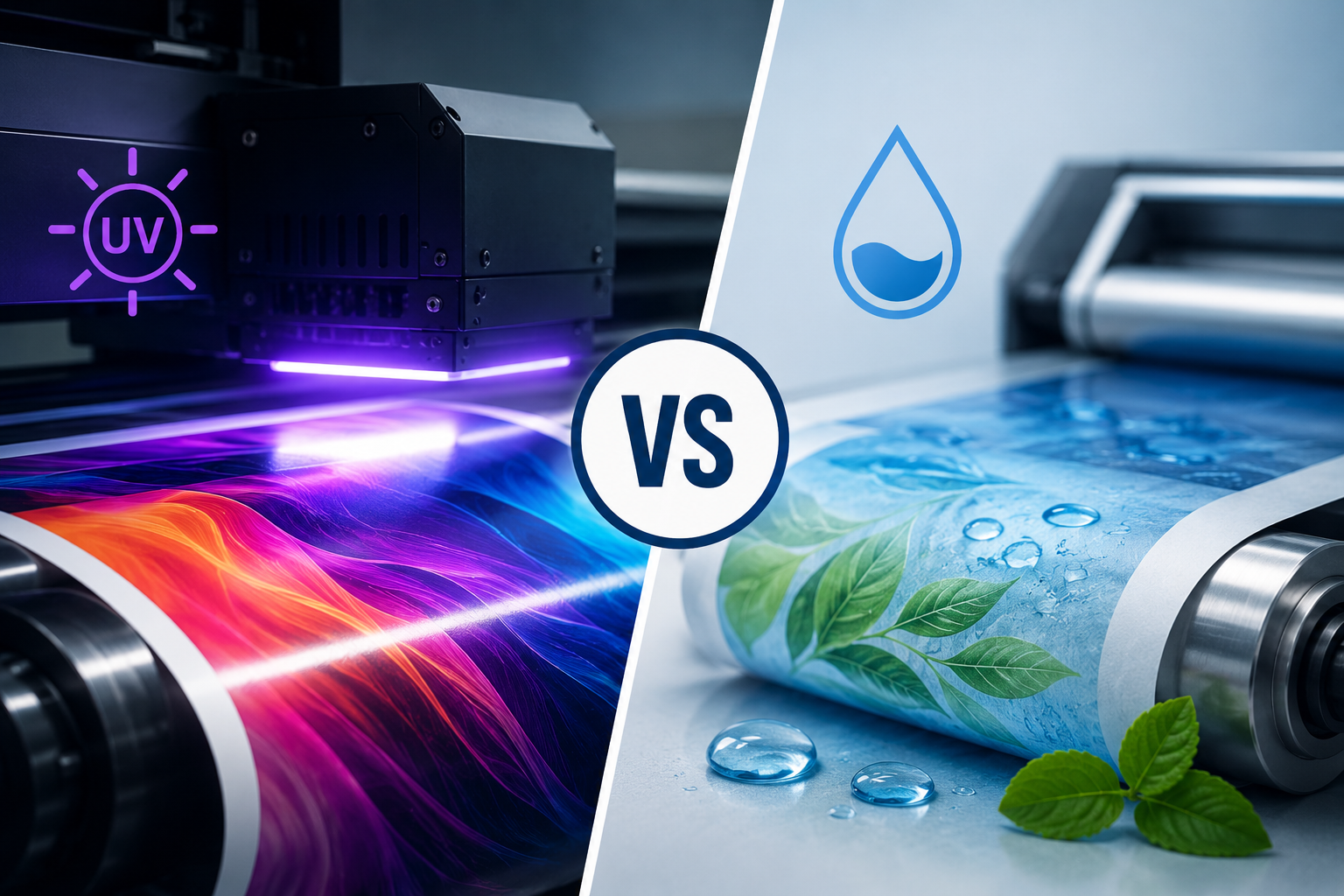
Printing businesses constantly weigh speed against sustainability when selecting an ink system. UV-curable inks and water-based inks both deliver vibrant, durable prints, but they perform very differently across substrates, production environments, and environmental compliance requirements. This comparison helps printing and packaging businesses choose the ink system that matches their actual production needs.
Innokan Technochem manufactures both UV-curable and water-based inks at its Haryana facility, supplying printing and packaging industries across India. The comparison below reflects direct formulation and application experience with both ink technologies.
Understanding UV-Curable Inks: How They Cure and Perform
UV-curable inks contain photoinitiators that trigger instant polymerization when exposed to ultraviolet light. Rather than drying through evaporation, the ink cures within seconds under a UV lamp, transforming from liquid to a solid, durable film almost instantly.
This instant curing mechanism allows UV-curable inks to print on non-absorbent substrates like plastic, metal, and glass, where water-based inks struggle to dry properly. UV-curable inks also produce minimal VOC emissions since the curing process doesn’t rely on solvent evaporation, making them attractive for facilities pursuing tighter environmental compliance.
Understanding Water-Based Inks: How They Cure and Perform
Water-based inks use water as the primary carrier for pigments and binders. The ink dries as water evaporates from the printed surface, leaving behind the pigment and binder film. This drying process works exceptionally well on porous substrates like paper and cardboard, where the material readily absorbs moisture.
Water-based inks offer the lowest VOC profile among common ink technologies, since water replaces the organic solvents found in solvent-based formulations. This makes water-based inks a preferred choice for food packaging and other applications requiring strict chemical safety standards.
UV-Curable Inks vs Water-Based Inks: Print Speed and Production Throughput
UV-curable inks generally support faster production speeds because curing happens almost instantly under UV exposure, eliminating the need for long drying tunnels. High-speed label printing, packaging lines, and commercial print operations benefit from this rapid cure time, since it shortens overall production cycles and reduces bottlenecks.
Water-based inks require longer drying time, particularly on less absorbent paper stocks or in high-humidity environments. Production lines using water-based inks often need additional drying capacity or reduced line speeds to ensure the ink fully sets before further handling or finishing.
UV-Curable Inks vs Water-Based Inks: Substrate Compatibility
Substrate compatibility represents the clearest differentiator between these two ink systems. UV-curable inks adhere effectively to plastics, films, metals, and other non-porous surfaces because curing doesn’t depend on absorption. This versatility makes UV-curable inks the standard choice for product labels, flexible packaging, and specialty printing on synthetic materials.
Water-based inks perform best on porous substrates like uncoated paper, cardboard, and certain textiles, where the material naturally absorbs moisture during drying. Attempting to use water-based inks on non-porous plastics typically results in poor adhesion and smudging, since the surface can’t absorb the water carrier.
Environmental and Health Considerations: UV-Curable vs Water-Based Inks
Both ink systems offer significant environmental advantages over traditional solvent-based inks, but they differ in specific considerations. UV-curable inks produce near-zero VOC emissions during curing, though formulators must carefully manage photoinitiator selection to address certain health and regulatory considerations around UV-cured products.
Water-based inks contain minimal VOCs and use water as the primary carrier, making them the safer choice for food-contact packaging and applications requiring the strictest chemical safety profiles. Facilities prioritizing worker safety and indoor air quality often favor water-based inks specifically for this reason.
How to Choose Between UV-Curable and Water-Based Inks
Selecting the right ink system starts with identifying your primary substrate. Non-porous materials like plastic films, metallic substrates, or specialty synthetics call for UV-curable inks, since water-based formulations simply won’t cure properly on these surfaces. Porous substrates like paper, cardboard, and certain textiles work best with water-based inks, which deliver vibrant color and strong adhesion without unnecessary VOC exposure.
Production speed requirements also influence the decision. High-speed commercial printing and packaging lines often favor UV-curable inks for their instant cure time, while operations with adequate drying capacity and porous substrates can achieve excellent results with water-based formulations at a typically lower cost per unit.
Partner with an Experienced Printing Ink Manufacturer
Choosing between UV-curable and water-based inks requires matching ink chemistry to your specific substrate, equipment, and compliance needs. Innokan Technochem formulates both ink systems with consistent quality control, helping printing and packaging businesses achieve vibrant, durable results while meeting sustainability targets. Contact Innokan’s technical team today to evaluate which ink system fits your production line best.
Frequently Asked Questions (FAQs)
Which ink type works better on plastic substrates: UV-curable or water-based?
UV-curable inks work significantly better on plastic and other non-porous substrates because they cure through UV light exposure rather than relying on absorption. Water-based inks struggle to dry properly on plastic, often resulting in poor adhesion and smudging.
Are water-based inks safer for food packaging than UV-curable inks?
Water-based inks typically offer the safest profile for food-contact packaging since they contain minimal VOCs and use water as the primary carrier. UV-curable inks remain safe when formulated correctly, but water-based options are generally preferred for direct food-contact applications.
Which ink system supports faster production speeds?
UV-curable inks generally support faster production speeds because the curing process happens almost instantly under UV light, eliminating long drying tunnels. Water-based inks require more drying time, especially in humid conditions or on less absorbent stocks.
Do UV-curable inks produce VOC emissions?
UV-curable inks produce minimal VOC emissions because curing relies on photoinitiator-triggered polymerization rather than solvent evaporation. This makes UV-curable inks a strong choice for facilities targeting reduced air emissions.
Can water-based inks achieve the same print vibrancy as UV-curable inks?
Water-based inks deliver excellent color vibrancy on appropriate porous substrates like paper and cardboard, though UV-curable inks often achieve slightly higher gloss and color intensity on non-porous materials due to the way the cured film sits on the surface.
How does Innokan help printing businesses choose the right ink system?
Innokan’s technical team evaluates your substrate type, production speed requirements, and compliance needs, then recommends or formulates the ink system that delivers the best performance. This consultative process ensures printing businesses avoid costly trial-and-error with the wrong ink chemistry.